
 Rabbitson Crusoe (1956)
Dir.: Friz Freleng
TC4P Rating: 7/9
Species: a purple shark named Dopey Dick, who is a little bit dopey and kind of a dick.
Believe it or not, I still own my very first edition of Daniel Defoe's classic novel, Robinson Crusoe. Please don't read that incorrectly. I do not own the first edition of Robinson Crusoe. Considering that the novel is just a hair under three hundred years old – having been first published in 1719, and thought by many scholars to be the first true novel in the English language – that would now make me a multi-thousand-aire, at least (and I am definitely not that at the moment).
 No, the first edition of Robinson Crusoe that I ever owned was – and is – a Junior Literary Guild Book Club edition from the early 1970s, itself a reprinting of a 1945 edition of the book, illustrated in a still appealing way by Fritz Kredel. I read and reread this volume multiple times as a child, and it definitely would have to count as one of my early literary influences. To this day, sitting on my library shelves, I still have a few other books from my time in that book club (the first of many) as a kid: Daniel Boone - Wilderness Scout by Stewart Edward White, 101 Dalmatians by Dodie Smith, Paul Bunyan and His Great Blue Ox by Wallace Wordsworth (which has been missing its cover so long that I can no longer summon an image of it in my mind), and Rascal by Sterling North (also sans cover, but I remember what that one looked like). Some have made it through the years better than others, but only one of those Book Club volumes has gotten a full rereading since I became an adult (and has, thus, remained in the best shape due to my attention to it), even though I owned both a paperback edition and a more recent, handsomely bound edition. That book is Robinson Crusoe.
 Though my politics and viewpoint towards the book (and mankind in general) have changed greatly since my early, youthful exposure to the story, I still find Robinson Crusoe a rousing adventure novel, not least of which is its location and setting, that of a man stranded on what we would term a "deserted" or "desert" island, though it is anything but a desert nor does it turn out to be deserted. The notion of a tiny little island with just sand and a palm tree is really the province of cartoonists, filmmakers, and sketch comedians, though when we hear the name "Robinson Crusoe," you would not be charged with wrongheadedness were you to summon up such a simple image at first. Of course, you would tend to add a slave in the form of a "Man Friday" to do Crusoe's bidding, but otherwise, the brevity of your casual daydream would be forgiven.
 The book, of course, is far more robust and detailed, and the island is equally lush and laden with the resources necessary for decades of survival, as long as Crusoe and his eventual co-habitant are willing to work for them. The book was so popular it created its own sub-genre – the Robinsonade – and all further stories of humans lost at sea and abandoned to the islands of the world's oceans have Defoe's book (and its two quickly written sequels, neither of which have I ever read) as its wellspring. Do you think the novel, The Swiss Family Robinson, written almost a full century later, is named that for little reason? (The name is meant to be evocative of Defoe's book. It is not the name of the family in the original German printing, that's for sure. The family is well aware of the novel Robinson Crusoe, and mention it and its title character several times within their own adventures.)
 Getting back to that original novel, Defoe really started something in the imaginations of men, women, and children all over the world. And despite what happens to the characters being stranded for so long from civilization on their own island before Crusoe is eventually rescued, the book itself evokes a romantic feeling for the notion of being lost and stranded at sea, however actually tragic such an occurrence often is for the victim. That's why when musing about getting away from the rat race of modernity, we discuss "desert island" lists, books, albums, and romantic partners. The notion of being trapped on a small circle of jungle-cropped land to choose between Ginger and Mary Ann is endlessly appealing to most men. (The answer, for me, is "both," though Mary Ann is the clear choice when all is said and done. Way cuter, smarter, and ultimately hotter than the overly made up and high maintenance movie star.)
 Yes, I still recall the novel quite fondly myself, and know that at some point in the near future I may settle into a couch somewhere and give it another good read. I have yet to find a feature film version of the story that I have considered completely satisfying, though I am certain filmmakers will continue trying. (And please do...) Many of the details of the book are thoroughly burned into my subconscious by this point, that it sometimes feels that I have actually absorbed the book into my bones as well. And yet, when presented with a small story detail, such as the presence of sharks within the framework of the novel, I had to think about it briefly. "Are there sharks in Robinson Crusoe?" I wondered. My mind told me, "Well, yes, there certainly must be," but I couldn't recall for sure. Inside, a mild panic started to bounce around my brain. "Good god, man! For the sake of The Shark Film Office, you need to figure this out!"
 This issue gets confused even further for me when other adaptations – and even parodies and spoofs – of Robinson Crusoe are released which do include sharks in the details. The book that I thought I knew so well starts to get muddled even further. And sometimes, these additions are so clearly out of bounds that they become ridiculous. This is fine when a comedic adaptation is meant, but sometimes creative license in straight dramatic versions can go just a little bit too far. But here is what I do know: Nowhere, in that original book, do I recall that its main character had to fend off the murderous advances of a man-eating shark named Dopey Dick.
 To find Dopey Dick, you have to go to the cartoons. You have to track down the Warner Bros. short titled Rabbitson Crusoe, directed by Friz Freleng, which was released as part of its Looney Tunes series in 1956. Lovers of The Bugs Bunny/Road Runner Show in the 1960s and 1970s will remember seeing this cartoon a zillion times, and frankly, this particular short was not of my favorites at the time. This owed nothing to the general excellence of the short's construction but more to the very company it was keeping. It is hard to be thought of in such grand terms when What's Opera, Doc?, The Rabbit of Seville, and A Froggy Evening are living right next door. But Rabbitson Crusoe has grown on me over the years, and within the reasons for such a thing to occur, the most important is its portrayal of the sneaky, ravenously hungry shark, Dopey Dick.
 The title of the film appears over a cartographer's rendition of an island on any ol' map. An orchestral version of the pop standard Trade Winds by Cliff Friend and Charles Tobias plays over the credits (and this is not by accident, as it will come into play later in the film). Mel Blanc's familiar voice as Yosemite Sam fills the soundtrack after the end of the credits as the story opens with Robinson Crusoe's narration of his diary. "A low tide and high rock caused my predicament. The ship's supplies used up, my only food supply was a lonely coconut tree."
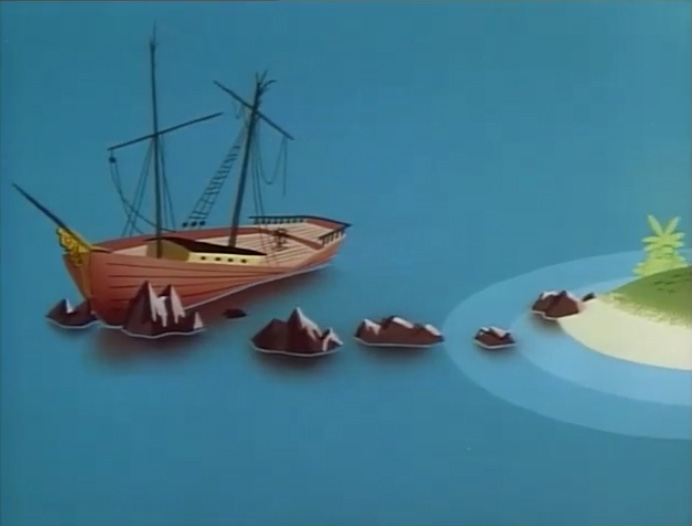
 Trade Winds continues to play in the background as the camera pans from a shipwreck sitting high in the water, over to a series of rocks leading to a small island whose only feature is a hut on stilts with a ladder, and then another series of rocks, and finally another small island upon which stands the lonely coconut tree mentioned in the narration. Sam continues to spin his yarn as the camera zooms in on the island with the tree, saying "Gathering coconuts was a problem because of a dangerous, man-eating shark named Dopey Dick." (See? I got it from somewhere...)
 Amongst the rocks, we see a shark's large black dorsal fin swim into view, ominously swirling about in a circular motion. Sam as Robinson Crusoe, on the island with the hut, walks to the edge of the water and looks around the rocks to gauge any potential places where the shark might be lying in wait for him. A closeup on the rocks reveals Dopey Dick to have his head up out of the water as he peers around one large rock to eye his intended prey. Sam does not see the giant fish, and so starts to hop in a rather cute way across the first few rocks, almost like a small child attempting a playground skipping game. Suddenly, he spins his head around behind him to see the shark advancing on him, snapping its jaws as it chases him across the remaining rocks to the other island!
 Once there, the shark follows Sam straight up the low-bending trunk of the coconut tree, almost like a toothy guard dog. Far up the tree, Sam reaches to a hook on the trunk from which a large mallet hangs suspended. He starts to beat Dopey Dick hard on the head over and over again, yelling, "Back! Back! Back! Down, ya shark-livered varmint!" (Well, he is a shark, so it stands to reason he may be "shark-livered," unless he had some form of transplant.) Dopey Dick yelps sharply like a beaten dog and beats a hasty retreat to the safety of the ocean. "Danged ol' fin-flappin' flounder," mutters Sam as he hangs the mallet back onto its hook.
 Sam pulls down a coconut and walks back to the rocks. He looks about for safety's sake, and seeing nothing, gingerly tiptoes onto the rocks. Almost immediately, there is a splash and Dopey Dick is giving him chase again, snapping his huge jaws over and over at Sam's heels. Sam reaches the shore of the other island, where he has a rack filled with numerous baseball bats, sitting there for the sole purpose (presumably) of smacking Dopey Dick on the head. Sam grabs some pine and charges back at the shark, who sees Sam coming and beats it once more for the ocean. "Twenty years tryin' and ya missed me again!" Ya shovel-nosed mackerel!" yells Sam, raising his fist at the water and then swinging his bat. "No good bushwhackin' barracuda!"
 A short while later, we are shown a cookbook that reads 1000 Ways to Prepare Coconuts, and we then see Sam sitting down to a meal entirely comprised of them. At first, he seems happy with this spread: "Mmm... tossed coconut salad. Fresh coconut milk. New England boiled coconut." After he sniffs his main course and replaces the lid on the serving tray, he has a change of mind though. "Ooh... I HATES COCONUTS! Twenty years of coconuts! I can't stand coconuts!" He brushes the entire meal, dishes and all, away with an angry swipe of his stubby little forearm and then starts to beat his head hard against the bamboo support of his hut. All of a sudden though, he hears another voice in the near distance singing the song Trade Winds. It is the wonderful voice of Bugs Bunny, also provided by the talented Mel Blanc...
 "Down where the trade winds play
Down where you lose the day
We found a new world where paradise starts..."
When Sam looks to the ocean, he sees (as we do too) a small box floating on the waves, in which Bugs Bunny is draped casually as he chews carrots one by one, leaving the carrot tops to float lazily in the water in his wake. Sam recognizes a stewing rabbit, of course, but calls out to the rabbit all friendly-like, summoning him to shore. Bugs is overjoyed at this, believing he is "saved at last" and starts to paddle in that direction. Soon, he is riding the box at the top of a large wave that threatens to crash down hard on Sam, but all that happens is that Bugs drops out of the box into Sam's waiting arms.
 "Oh, boy! Dry land!" exclaims Bugs. "It sure feels good to be dry again!" But no sooner does he say this than Sam drops the critter into a large kettle sitting atop a bed of firewood. As Sam lights the fire, Bugs asks, "What's the big idea? What's up, doc?" Sam announces his intention to make rabbit stew out of Bugs and asks, "Get the idea?" and then laughs wickedly. Bugs response is to say he does get the idea and then starts to mock Sam's laugh, losing steam halfway through at the possibility of his own demise. Bugs asks how long until dinner is ready, and Sam tells him it will be just a few minutes, barring accidents. Bugs says, "Oops!" and pours an entire ladle of water from the kettle onto the firewood, putting out the fire. "Foist accident," he says calmly, tucking his hand under his chin as he rests his elbow on the edge of the pot. Sam is livid. "D'oh! Ya stupid id'jit rabbit! Don't ya know matches is scarce on this island?"
 Sam now has to march across the rocks to the shipwreck to get another match. At the water's edge, he carefully starts to step onto the first small black rock, but it turns out to be Dopey Dick lying in wait for him. The shark snaps its jaws down hard, and when Sam pulls back his foot, the front half of his tiny brown boot is missing. He sticks a single toe out of what remains and has it look around the corner of the boot for more trouble. Finally, he sticks his remaining toes out with it. "Ha! Missed again, ya hammerhead halibut!" Sam picks up a small bone and whistles to the shark as if he were a pet dog. "Here, boy! Here, go get it!" He throws the bone towards the horizon and the shark speeds off after it. Sam races across the rocks to the ship and runs into the cabin. He opens the safe and then pulls out a small drawer, inside of which are numerous matches. Sam grabs a single match and then races back across the rocks.
 When he reaches his island, he races back to the stewing kettle to relight the fire. But he suddenly realizes the rabbit is no longer in sight. When he goes to look over the edge of the kettle, the shark leaps up out of it and gulps Sam down its maw in a single gulp. Well, everything but Sam's legs, which carry Dopey Dick upside down around the island in a staggered, clumsy walk. Sam finally (somehow) is able to find a mallet and start bashing the shark in the head with it. Dopey Dick quickly leaps off of Sam's body and rushes yelping once more for the water, leaving Sam to bash himself in the face with the mallet several times, after which he is left seeing stars.
 Once Sam finally gets his sights righted, he starts to wonder where the rabbit went. "Yoo-hoo!" yells Bugs, sitting out on Sam's ship. "Mr. Robinson!" (This is the first and only time that there is a direct reference to Sam having this name in the cartoon.) Sam sees where the rabbit is and goes bonkers. "I'll get ya, ya long-eared galoot!" he yells, "Shark or no shark!" Sam disappears from view and then runs back into frame with a surfboard. He dives into the water and doesn't make it very far until he realizes that he is sliding straight into the open, waiting mouth of Dopey Dick. After it closes its jaws, the head of the gigantic fish is contorted by Sam's efforts to free himself, and then he zips out, still lying on his surfboard, and he paddles fast for the shore.
 Back on the ship, Bugs lies draped along the bow and sings a couple of lines from the then popular ballad, Secret Love (written by Sammy Fain and Paul Francis Webster)...
"Once I had a secret love
That lived within the heart of me.
All too soon my secret love
Became impatient to be free..."
While Bugs croons, Sam makes preparations to attack the ship. He ties a large pink balloon to himself and says, "This time, I'll outsmart both of 'em!" He holds a wet finger in the air and realizes the wind is just right, and so Sam pushes a large rock off the string that ties him to the balloon so he can float into the air. When Sam starts to float down towards Bugs on the ship and cackles maniacally in victory, Bugs kicks open a hatch and Sam suddenly finds he is floating straight down towards Dopey Dick, who sits patiently down in the water inside the submerged hold. (It's actually a nice little detail that they remembered they were running around a shipwreck.) Bugs leans calmly on the hatch's edge as Dopey Dick and Sam duke it out in the water unseen. Finally, Sam comes up the stairs beating the shark away with a club while he yells, "Down, down, down, ya sharp-toothed salmon!"
 Sam shuts the door to the stairwell, and then goes after Bugs who is hopping lightly across the rocks to the island. Sam catches up to him and grabs the varmint. He throws Bugs back into the kettle, relights the fire, and then picks up his cookbook for instructions. Bugs points behind Sam and shouts, "Look, it's a tidal wave!" but Sam doesn't believe him, thinking it is meant as a distraction. (To be fair, Bugs does say it somewhat insincerely, probably his worst line reading.) Sam yells back at the rabbit, "Shaddup and start simmerin'!!" but as soon as he does, Sam hears the loud rush of water behind his back. There is a neat shot of the silhouetted pair against the massive wave heading in their direction, and then they are swept away, with Bugs still inside the kettle.
 "Holy, carrot sticks!" says Bugs in astonishment. "The island's gone!" Sam swims up screaming for help as the shark chases him in circles around the kettle. He begs the rabbit to pull him in, and Bugs agrees, telling Sam to "keep his shoit on!" Bugs pulls a boat hook out of the kettle (who knew he had one of those?) and lifts Sam out of the water by his shirt. Sam demands to be pulled into the kettle, but Bugs wants to cut a deal. Sam refuses so Bugs puts him back into the water. Sam swiftly agrees to the deal, and the next thing we see is Sam slowly paddling the kettle through the water as he hangs from the end of the hook, still several feet out of the kettle. Dopey Dick follows close behind, his dorsal fin sticking up out of the water. "After all, a deal's a deal," says Bugs. They pass a sign that reads, "San Francisco – 2736 Miles". As Dopey Dick chases them, Sam starts to paddle even faster towards the horizon as California, Here I Come is played on the soundtrack. Iris out.
 I find Rabbitson Crusoe a lot more fun now than I did when I was younger, and that probably has something to do with the end of my close obsession only with Chuck Jones cartoons in my early days (though, honestly, when I watched them on Saturday mornings, the individual shorts did not have credits). But I could tell the different styles apart, and it turned out that the Warner Bros. cartoons which I revered the most in childhood were the Jones' offerings. I also loved a lot of the Friz Freleng shorts as well, but this one got booted aside. Now, I find it completely endearing, and as I mentioned earlier, Dopey Dick is the main reason.
 This is one of the rare earlier cartoons where the shark is a fully developed main character along with the other two in the film. He gets fairly equal screentime with the Bugs and Sam, and is given a chance to be both sinister and funny as well. Like any hungry predator in a Warner Bros. cartoon, we simultaneously want Dopey Dick to succeed in his life's mission but also want him to fail in largely comic ways. Sam is so annoying and downright villainous in his own right that he completely deserves to be eaten by Dopey Dick, far more so than Bugs deserves to be eaten by Sam. After all, according to Sam's own dialogue, Dopey Dick has been trying for some twenty years to capture his prey. Why shouldn't he?
 As for design, this is one of my favorite cartoon sharks. He does get to give a couple of early menacing looks, but for the most part, Dopey Dick is kind of goofy looking. Especially in profile, with his grandly elongated snout and widely spaced teeth that hang down almost like vampire's fangs, though there are usually three to five of them. There are couple of shots where it almost appears as if his dorsal fin works like a hat atop his head rather than in the middle of back, which is easier to do when your mouth is drawn in most cases to take up anywhere from the front third to a full half of your body length. (Those shots also happen to be when he is standing on his tail and his back is arched, which further adds to the impression of a sharp, pointed hat resting atop a big bald head.) His is a really simple design, but quite effective, and adds a lot to the comedy, where he is just rubbery enough to get some good reactions to Sam's outbursts of reactive violence. Another nice touch is the constant reminder that the shark really serves as some sort of stray dog loose in Sam's neighborhood, and Sam has adjusted his own behavior (and thus, the shark's) accordingly. Naming the shark Dopey Dick after yet another literary monument, that of Moby-Dick, or The Whale by Herman Melville, is also rather a fun move.
 In bringing this back around to Robinson Crusoe, a quick search of the novel online finds no mention of the word "shark" within its text, and I also did searches for the word "fish," thinking that Defoe, writing in an earlier age where the word "shark" was not quite as prevalent or even immediately as prone to invoking fear, might have opted for "giant fish" or some other such sobriquet. No such luck, just some mentions of being taught to fish in his youth, etc. It really does appear that I will need to sit right back down and actually reread Robinson Crusoe once again to get my query resolved for good.
If only I had a decent copy lying around...
RTJ
[Editor's note: Rabbitson Crusoe has yet to appear on DVD or Blu-ray from Warner Bros. It was released on laserdisc and VHS back in the day, though I am unable to locate my own VHS copy for whatever reason. It does appear online in a couple of places, but I am unwilling to link directly to them in this post as they do not appear on YouTube. You can do a search and find them. If you do, keep in mind that one version out there on Vimeo is fully dubbed in Italian, which makes for a really interesting contrast against the English version. Have fun with that.]


