Bambi Meets Godzilla (1969)
Dir.: Marv Newland
Cel Bloc Rating: 8/9
I can remember the first time that I saw Bambi Meets Godzilla. It was on HBO when I was a teenager in the late '70s and my dad, whom we only visited every other weekend, had moved into a condo in East Anchorage. The cartoon was shown in one of those open segments between movies where the cable channel would show any number of short films, interviews, or movie trailers to fill the gap between feature films, boxing matches, and concerts.
I wrote recently about another one of these shorts shown on HBO in those days, that may be of interest to animation buffs, called Recorded Live, released in 1975. The difference between the two films is that I actually videotaped Recorded Live eventually, quite by accident, and watched it many times over the years until the tape either got eaten or was lost. Whatever happened, I lost track of it and didn't see Recorded Live for many, many years until earlier in 2015.


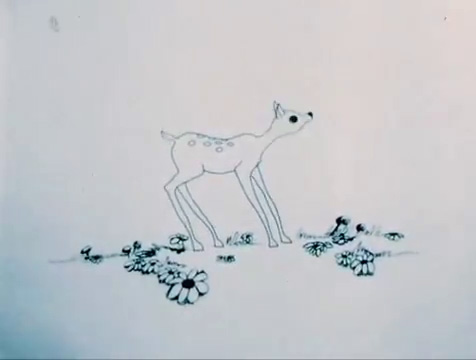
 Bambi Meets Godzilla is another matter. There was no buildup to the film, and I had no idea what the next film was even going to be called. I just looked at the screen (I can't even remember if my brothers were watching with me at the time), and there was a traditional countdown clock like when you watch a film reel on a projector. Then a cartoon started featuring an all-white screen with a line drawing of a cute little deer standing amongst a rather spare field of flowers. The words Bambi Meets Godzilla popped up above the deer's backside, and there was a pastoral music theme (more on that later) that I recognized in my youth but did not really know what it was. The credits for the film roll by in a quite scattershot and low-budget fashion, and then WHAM! A giant, monstrous foot squashes the poor deer into the ground!!! This would be the appearance of Godzilla, in case you hadn't figured out where this was going yet. While the foot remained in place, the last of the credits flash on the screen. And the film is over.
 I did not record the cartoon on videotape (we didn't have a machine for that quite yet), but looking back, I sure wished that I had at the time. Because after that brief viewing -- the cartoon is barely 90 seconds long -- I did not see Bambi Meets Godzilla on HBO again. But the mystery of the film was lodged in my head for eternity. What did I just see? Who is this Marv Newland, the guy whose name appears in the credits over and over? And who would do that to poor little Bambi?
Let's set some more time frame. While I had seen scenes of Walt Disney's Bambi throughout my youth on The Wonderful World of Disney, I did not see the feature film fully until it was rereleased to theatres in the summer of 1975, when I was eleven years old. Our babysitter, Mrs. B. drove my brothers, a couple of other kids she watched, and I into Anchorage from her home in Eagle River (where we grew up). Insisting on sitting in the backseat but deciding to read on the way, I got carsick and we had to stop the car so I could throw up. After the movie, we went to a BBQ place for lunch, which was the only time that I ate at that restaurant until about fifteen years later. (And now it is no longer there, but it is no loss.) Oh, yeah... and I remember a couple of the kids crying in the car on the way back to Eagle River because of what happens to Bambi's mother. And Mrs. B. had to gently talk them down and explain what had happened. Ah, Walt Disney... torturer of children's psyches.


But I digress... it's now four short years later, give or take, Bambi was still pretty alive in my memory, especially given how upsetting the film was when I saw it, and now I was being confronted with the fact that a monster with whom I was even more recently first acquainted had smashed a friendly cartoon deer flat on the screen in front of me.
 That's right... Godzilla had become my friend over those past few years. While I grew up always knowing what he looked like and who he was, I didn't see a film with Big "G" until NBC showed a dubbed version of Godzilla vs. Megalon, one of the worst of the series, on prime-time television in the summer of 1977. Best of all, it was hosted by John Belushi wearing a Godzilla costume. (He had also played Godzilla in a Saturday Night Live interview sketch, which I had seen because I was staying up late on Saturday nights to watch the show, sometimes under the radar, from the very start of its run.) After that, my new Godzilla fetish was fed constantly Famous Monsters of Filmland magazine and by mid-afternoon matinee showings of monster and sci-fi movies on KTVA Channel 11, which I preferred to do instead of doing things like, oh you know, homework. Destroy All Monsters, King Kong vs. Godzilla, Mothra... I had them down already. So, by the time Bambi Meets Godzilla rolled around for me on HBO that day, I was fairly well acquainted with the parties involved in this Epic Battle for Supremacy of the Universe.
 And then Bambi Meets Godzilla happened. My sense of humor was always intact, and I was fully immersed in parody and satire because of my love for MAD Magazine and its various offshoots and competitors. It was my sense of irony that was still being developed, even if I didn't understand the term at the time. And I remembering laughing hard at BMG when I first watched it, because... how could you not? The title was funny in and of itself, the credits were even funnier, and then there was the image of that huge reptilian foot crashing down on top of a cute little cartoon deer and crushing it until its little legs splayed and stuck out from underneath. To a kid or a teenager, that is always hilarious.
 But there was something else... it kind of scared me a little. I have always been a little hypersensitive to how music makes me react to popular entertainment, even when it is meant to make me laugh or smile. There were a handful of clips of the Muppets on the original Sesame Street that served to give me the creeps mostly because of how music and sound effects were employed. Not so much when the clip would be shown, but later, when I would think about the music and what it triggered onscreen, I could give myself a chill. And Bambi Meets Godzilla did that for me in the same way.
 But to get to that, let's go through the film. As I mentioned, there is a countdown film leader at the beginning of the short, whereupon we meet Bambi, or what we take to be the filmmaker's version of Bambi. This film being a parody, it rather escapes the use of copyright in securing the use of both of these characters, though such use on the part of the monster is remarked upon later in the credits. So, we will go with this being Bambi, for all intents and purposes and proceed onward.
There is the title that hangs above the little deer, and then the credits scroll slowly upward, though not in a steady way, and it is clear from the way they are quite crooked in their angle and the variance of speed as they make their way upward that this is a pretty ramshackle affair (however intentionally). Bambi forages amongst the flowers, lifting its head up and back down again to the Ranz des Vaches portion of Rossini's William Tell Overture. The music is often used in pastoral scenes in cartoons and films, and so its appearance here is to given the viewer an instant recognition that the mood is meant to be one of complacency and comfort.
 As the deer continues to forage, occasionally tapping a hoof on the ground, the first of the credits appears. It reads, all lower case, "written by marv newland," and the viewer immediately goes, "Who is Marv Newland?" Then the next credit comes up reading, "screenplay by marv newland," and we realize that the joke is really on for good. The next credit says, "choreography by marv newland," and please keep in mind that to this point, we have just seen a deer lolling about in some flowers. What choreography? Do they mean fight choreography or dance choreography? Is this going to turn into a musical? Having never seen the film, and not knowing of its brevity, anything could happen at this juncture.

Then we know for sure we are being had. "bambi's wardrobe by marv newland" reads the next credit, which scrolls past slightly faster than the ones before, almost like the director is trying to slip one past us. Then the credits get slightly more serious with a "produced by marv newland" credit, but then shift back again with the best one yet, "marv newland produced by mr. & mrs. newland."
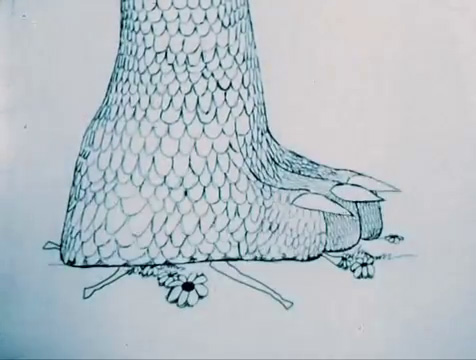 Up to now, Bambi has continued his foraging, but after the final credit hovers ever so briefly longer at the top of the screen, it disappears. Just under the minute mark of the film, Bambi looks up -- and then down comes the giant foot of Godzilla! It is quite cartoonish and somewhat blocky in shape, except for the toes that jut forward, and covered in scales that we assume would be green were this in color at all. (Yes, as you can see from the photos, it is in black and white. Deal with it... it's only ninety seconds.) The pastoral Rossini tune has been replaced with a long, ominous tone as the music crashes down in concert with the stomping of the foot like someone using a sledgehammer to smash in a piano lid.
  That ominous tone is held for the remaining thirty seconds of the cartoon. At the 1:08 mark, "the end" pops up one word at a time, and after being held shortly, disappears one letter at a time from the screen. They are replaced by "we gratefully acknowledge the city of tokyo," which itself is replaced by "for their help in obtaining godzilla for this film." The words disappear for good, and then, just in the last three seconds of the film, the monster's claws, static to this point, raise up and then go down creakily. The film fades to black.
 It was that final chord with Bambi getting stomped, so dark and so unforgiving even while jokes are told upon the screen to the right of the monster's foot, that stuck with me. I knew the cartoon was supposed to be funny, but something else resonated with me. After all, if a cartoon deer wasn't safe from the rampaging of a giant fictional monster, how would any of us be safe? Even if I considered that monster a friend -- and this might be because I did not see the original Gojira film, where he is a full-on villain, until many years later, having watched any number of Toho movies to that point where he team up with other monsters to save the earth from even worse monsters -- Bambi Meets Godzilla gave me something that none of those equally silly films ever did... an actual scare, however determined by my own neuroses and fears.
 And then, Bambi Meets Godzilla left me for a few years. I remembered it well, but I never saw it on HBO again. Thus, I never got a chance to possibly videotape it for my own eventual massive movie collection. But it did not totally disappear from my purview. In a few short years, animation festivals would come to a local independent theatre in Anchorage called the Capri Cinema, and I would attend every single one -- Spike and Mike's, etc. On a couple of occasions, BMG would be in the mix. In 1986, rockabilly artist Johnny Legend and Rhino Home Video put out a trio of Weird Cartoon collections, all of which I still own, and on which BMG could be found. That would be the moment when I started watching it quite regularly, and it became one of my favorite films to show people that had never encountered it before.
So, just who was this Marv Newland guy? Well, he eventually formed an animation company called International Rocketship and was instrumental for many years in distributing independent animated films around the world, in addition to creating his own. According to the book, The Fifty Greatest Cartoons (edited by Jerry Beck, 1994 Turner Publishing), Marv Newland put this film together as a film student in 1969 in Los Angeles, creating it in the last two weeks of the semester. The film shows it, certainly, but what he created has resonated enough with his fellow animators over the years that over a thousand of them voted Bambi Meets Godzilla #38 in that volume, mixed in between films from Walt Disney, the Fleischer Brothers, and Warner Bros. If that is not testament enough for how effectively the film works on an audience -- it sets up its premise clearly and bluntly, and pays off in hilarious fashion -- then I don't know how to convince you.
Me, I was convinced by a single showing on HBO one evening when I wasn't expecting it. And it has never left my mind...
RTJ
****
And in case you haven't seen it...