
 Toyland Premiere (Universal Cartune Classic, 1934)
Dir.: Walter Lantz
Animators: La Verne Harding, Lester Kline, Fred Kopietz, Bill Mason, and Manuel Moreno
Cel Bloc Rating: 6/9
I do have a small fondness for parades. Not a big love for them, but just enough of a fondness where if I hear one is going on, I would not be upset if it blocked my path for a while. I have taken part in many parades as well -- mostly for the Fourth of July -- thanks to my old theatre friends, who make it a point to join in on the fun on a regular basis whenever they are asked. (I have certainly taken part in many things I would not have normally because of them.)
 As for holiday parades, well, I have only participated in a couple of those. I suppose that if I lived in a much bigger city like New York, I would probably at least attend something like the Macy's parade just to say I had seen it in person once. Growing up as a fan of the original version of Miracle on 34th Street, it is naturally an attractive idea to me, and I have always liked Macy's as well just because of that film (even though I have only shopped in Macy's just a very few times).
 So, how about a cartoon involving a similar parade, where Santa Claus is invited annually to lead the spectacle, along with his elves and reindeer, and delight thousands of children and their parents? Toyland Premiere is the film that fulfills this need, released in December 1934 by Walter Lantz, the future creator of Woody Woodpecker. Technically, Toyland Premiere is an Oswald the Lucky Rabbit cartoon, even if the character is only seen briefly in a few quick scenes and does little to nothing in the way of advancing the plot or fully taking part in the action.
 Instead, Toyland Premiere is focused mainly on the character of Santa Claus, the one from the North Pole with the sleigh and the presents and the reindeer and the "Ho Ho Ho". You know... that guy (the one we mentioned just a paragraph ago). After we, the viewers, enter through the gates of Toyland, his presumed home in this film, we see an elven creature dressed in a telegram delivery uniform running as quickly as he can without tripping fully over his long, white beard. (He does stumble here and there.) He yells, "Telegram for Santa! Telegram for Santa!" over and over as he runs.
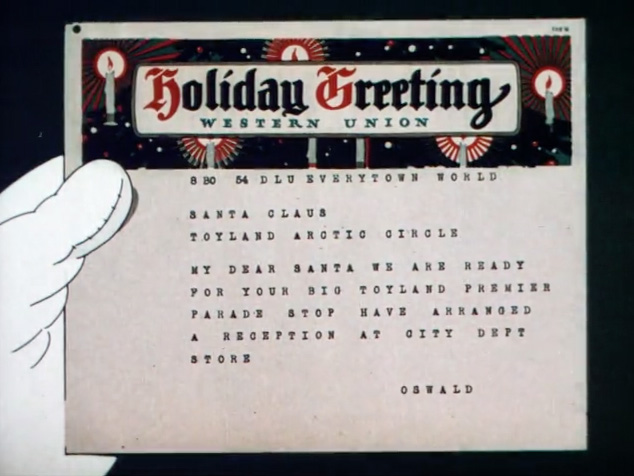 When we first spy Santa, he is not what we have come to expect. He is sitting on a low stool, clad in bright blue overalls and a matching cap, and also wearing what I presume to be the requisite red under-garments beneath the overalls. He is adding tails to a series of toy horse so slowly, that I can only believe that I can only surmise that he delivered presents to only 452 children that year. (Not the most efficient guy...)
The Western Union telegram reads, "MY DEAR SANTA WE ARE READY FOR YOUR BIG TOYLAND PREMIER PARADE STOP HAVE ARRANGED A RECEPTION AT CITY DEPT STORY" and is signed simply, "OSWALD". Santa immediately laughs heartily, and tells his entire squadron of elves, "Get ready, boys, for our big show!" The elves respond in unison, "OK, Santa! Here we go!"
 The elves start dressing themselves as a team in preparation, with two elves holding a costume open while a third elf jumps inside. One elf, much smaller than the rest, is dwarfed by his outfit and ends up running hard with his head into a nearby post. Santa is seen opening a decorative storage box held shut with a ribbon, and we assume he is going to retrieve his famous costume from within it. However, when he pops the lid, scores of moths fly out, and his costume has been rendered down to a single, small, tattered remnant. As he holds it up sadly, a single moth returns to pull the remnant from Santa's grip and take it away from him.
 Santa returns to the low stool, puts his head in his hands, and begins to weep. "Woe is me! Woe is me!" When he explains to the concerned elves that he can't lead the parade without his suit, they jump into action. They fill a Flit gun (look it up, kids) with red paint and then spray his blue overalls until this match his red under-garments. They string a bunch of popping corn (unpopped, so that needle must be amazing), and then wrap it around his prodigious waist and his cuffs. They hold a match to the string and the popcorn pops instantly all around Santa, giving him a white sash like he had on his original coat. When Santa stands up to inspect their handiwork, another elf runs up with a paintbrush to cover the area where he had been seated on the stool in red as well. (Technically, we never see him finish painting the tiny blue hold in the photo to the right.)
 Trumpeters sound the clarion, and as Santa, his minions, and a series of giant balloons march out of Toyland to make their way to the big city, we hear some female voices sing these words...
"One day in every year,
Ol' Santa takes a rest,
and leads the big balloon parade
dressed in his very best!
He leaves his Arctic palace,
and drives off in his sleigh
to tell the population that
the toys are on display!"
 As they sing, we see huge clown, pig, and penguin balloons, and then we see the entire procession flying off over the Arctic mountains. To the slightly modified tune of Jingle Bells, we see Santa fly down to the streets of the city followed by his parade. Then, as he slides along in his sleigh and is covered by confetti from the crowds, the original song resumes...
"He calls on ev'ry city
in ev'ry land and clime
so all the boys and girls will know
it's almost Christmas time!
The people on the street
have come from far and near
to follow Santa to the store
and see the toy premiere!"
As the parade passes before us, we see more of the giant balloons he has brought, including Mother Goose, a very fat baker, what looks to be Humpty Dumpty in a fine suit, and a truly wicked-looking clown. Elves leap about and perform acrobatics, and a float is shown with seals balancing balls on their noses, while other elves spin about on top of the balls. The song continues as we are shown more elf acrobats and jugglers.
"See the dwarfs, funny-men,
each one is a clown.
They cause a lot of laughter as
they travel through the town."
 For He's A Jolly Good Fellow is then heard as more balloons amble down the street to the corner where the City Department Store sits. Santa is greeted by the 1934 Universal version of Oswald the Lucky Rabbit, who has been scrubbed of his rougher elements, and is now pretty indistinguishable from many of the other Mickey clones of the era. (Keep in mind that he started out as the original Disney character, and was only replaced by Disney and Ub Iwerks with Mickey when Oswald was stolen from them.) "Welcome, Santa Claus!" says Oswald, and then he leads Santa to a curtain. When it is pulled back, the Toy Department is revealed, and in front of it is a banquet table featuring many stars of the day.
 "Meet the gang, Santa!" says Oswald, and we then get closeups of each celebrity at the table. Johnny Weissmuller is first, though it seems as if one of the animators really hated Maureen O'Sullivan. (While her caricature isn't too bad at first, she seems more like Joan Crawford later in the film.) Johnny, dressed and acting as Tarzan of course, says in broken English, "Me... like you!" and points at Santa. Shirley Temple, standing on the table, greets the jolly old elf, and then Laurel and Hardy do a little fancy tipping of their bowler hats in unison.
  Eddie Cantor, completely in blackface, makes a few of his signature lip-popping noises (or that at least served as a signature when he was being lampooned by others) and waves, while Boris Karloff dressed as the Frankenstein Monster sits silent and glaring to his left. Next is Bing Crosby, who greets Santa with a "Howdy-do-doo-do-doo-do" in singsong fashion. He then starts to whistle, and we realize quickly that it is not Crosby's voice at all when he begins singing. The song is picked up by Temple and Cantor (though not their real voices), and the lyrics, sung to what sounds a very modified version of Makin' Whoopee, are:
 "Hear what we want this Christmas season!" [Crosby]
"I want a drum, a ____op (??)
A hobby horse, a lollipop
A little tu-hoon
that I can croo-hoon
Will make me happy!" [Temple]
"I want a doll with eyes of blue
and golden curls and dimples too!
One of those dollies
that's in the Follies
Will make me happy!" [Cantor]
 As they sing, Oswald is switching the colors on the spotlight from red to blue for Shirley's song, and then, naturally, to black for Cantor, so that only his lips and eyes show up on the stage. Laurel and Hardy have gotten up from the table during the show, and eyeing a giant cake with criminal intent. When Hardy tries to take a cherry from the middle of the cake, he is slapped by a butter knife that is held by Boris Karloff. He screams, "Scram!!" at the pair, and they head for the hills. Running into the Costume Department, they happen upon a large dragon costume, and after doing some small bits of usual Laurel and Hardy schtick, Ollie whispers a plan into Stan's ear.
 Santa is elated at the reception. "I thank you for this party from the bottom of my heart," he declares. "So here's a toast to Oswald! Now let the party start!" (This is the last moment that we actually see Oswald in the picture, not even at the ending.) Meanwhile, Laurel and Hardy are seen approaching the party again, this time dressed in the dragon costume. They happen upon a blowtorch and put it inside the dragon's mouth to use as a flame. When they walk up to the table, Weissmuller faints dead away, and O'Sullivan is left to protect her onscreen beau. She picks up her Tarzan around the waist and leaps up to the ceiling, where she swings from chandelier to chandelier while opening her mouth to ridiculous proportions to scream out her take on the Tarzan jungle yell.
 The dragon walks up to the table and everyone else hides. They make an attempt at the delicious cake, but they are blocked yet again by Karloff, who makes them scram by simply saying, "Booooo!" They run away, but end up getting wrapped around one of the floor columns and crashing into each other. A lamp fixture falls and smacks them on the heads, causing starts to swirl about them. Santa crawls out from under the table and sees who has been causing the mischief. He pulls out a bugle and produces a call to arms.
 Toy soldiers leap out of boxes to join the fight, while tanks, mounted horsemen, dirigibles, and planes head towards Laurel and Hardy. The planes swoop the pair, still in the dragon costume, relentlessly and they trip all over themselves trying to escape. Jack in the Boxes spring up to use peashooters on them, and when the third Jack's attempt is spoiled, he snaps his fingers as if to say, "Nerts!" Toy soldiers mount a machine gun on a roller skate and fire on Laurel and Hardy. When the pair get trapped, the soldiers hop on tubes of paint and squirt them in the faces.
 Santa laughs at this, and he too gets hit with paint, but he laughs it off and says, "This is more fun!" Santa picks up a pie from the dessert table and throws it into Ollie's face. Toy indians use a girdle as a makeshift bow and shoot arrows in Stan and Ollie's rears. They jump over the table and wave a white flag to announce their surrender. Everyone crawls out from the under the table and rejoins the party, while the elves and toys cheer around them. Santa sits down and makes an announcement. "Let's make a wish! Then we will all partake of this delicious chocolate cake!" Santa blows on the candles, but the cake rocks back and forth, and then with his final blow... well. We assume the cake splats Laurel and Hardy with full force, covering them in chocolate, but this is unseen in the only available version, which is an edited reissue print of the film, so we can only guess at the actual reaction of the comedians to the splatting. Regardless, the camera cuts back to Santa, who exclaims "Oh, boy! Some fun!" Then he laughs uproariously one last time. Iris out.
At nearly nine minutes long, Toyland Premiere sometimes doesn't seem to end, which wouldn't be a problem if the cartoon was funnier or sharper. Of course, if it was funnier and sharper, there is all the likelihood that it would have been cut down by a couple of minutes for the sake of timing. However, as a Christmas cartoon, this one has a lot of spunk and is guided solely by the spirit of frivolity. The opening scenes in Toyland with Santa and his elves (or dwarfs, as they are referred to here) are lovely, with some marvelous, detailed background work throughout the picture, but especially here. The entire cartoon is exceedingly colorful, though it's a whole lot of blue and red, since it is only 2-strip Technicolor being 1934 and all. (At some points, like with the spotlight scene, it almost feels like it is meant as a commercial for 2-strip Technicolor.)
The celebrity cameos are hit and miss, with the scene where O'Sullivan rescues Weissmuller as my favorite part of the show, and the Temple and Crosby caricatures being the least successful in my opinion. Laurel and Hardy are generally turned nicely, and one would hope so since they dominate the celebrity portion as far as screen time in concerned.
As for the parade in the film, it looks exactly like the sort of grand time that I would hope to have at a Christmas parade. It also makes me a little bit more jealous that I have never been to one of the real, big city parades that had giant balloons on display. Floats are OK, depending on the theme and design, so they run hot and cold with me, and apart from marching bands (which are always swell), most music in parades tends to be lip-synced, so that is not an attraction to me at all. But balloons of popular cartoon or fairy tale characters and creatures ten stories high? Always a thing with me. They are definitely my favorite element of the Thanksgiving parades when I watch them on TV, and it would be grand to see them in person.
Now that I have thought about it for a bit, Jen and I practically live at Disneyland, but we rarely take in one of the parades. When we were there last week with our friends from Canada (who until very recently lived here), the only part of the Christmas parade we watched was one that we were practically forced to see. We were trying to cross from Tomorrowland to Frontierland through the Town Square area, and we suddenly had several Pixar characters, including the plastic army men, blocking our path for several minutes. For whatever reason, the gap between portions where they allow those uninterested in the parade to pass through seemed longer than usual to me. It seemed like the section we were seeing was caught in slow motion. As the not particularly hot sun was shining down only on the spot where we were waiting and my eyes were not handling the brightness very well, my patience was rather tested. For once, my Oswald hoodie that I almost never wear up over my head found itself fulfilling its purpose. So I guess what I said earlier about not being bothered in the least if a parade crossed my path was utter b.s., because I got just a little bit pissy about the wait.
Of course, the section of Christmas parade we got stuck watching was utterly boring, and the Pixar characters were nowhere near as engaging as they are in the excellent Pixar Play Parade in Disney's California Adventure. (5-4-3-2... Fun!) And we also didn't get to see a section that had Santa Claus in it (still not sure if there is one), and frankly, apart from giant balloons, Santa's the most important part of any holiday parade.
I guess watching Toyland Premiere again and again certainly got my holiday spirit revved up, if only a little. I got Santa Claus. I got giant balloons. I got Frankenstein's Monster, Laurel and Hardy, and Tarzan. And I got a wee bit of Oswald the Lucky Rabbit. That is a pretty packed Christmas stocking. Thanks, Santa (and Walter Lantz)!

And in case you haven't seen it: Toyland Premiere (1934) is available on the Woody Woodpecker and Friends Classic Cartoon Collection, Vol. 1, still in print as of 12/5/15. It also can be seen here and there on the internet, though it tends to come and go and the quality varies. Good luck!


