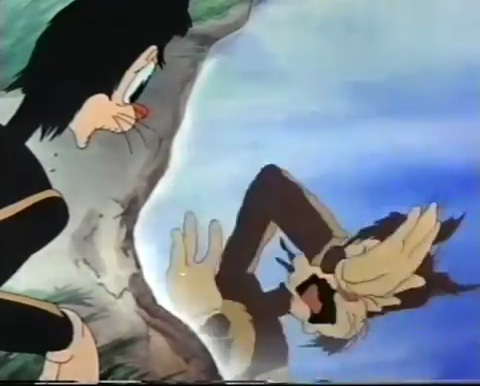
A Cold Romance (1949, Twentieth Century Fox/Terrytoons)
Dir.: Mannie Davis
Animators: Mannie Davis, James Tyer & Carlo Vinci (all uncredited)
TC4P Rating: 7/9
One of the cartoon series that I find most fascinating are the Mighty Mouse shorts from Terrytoons, a series that started in 1942 with The Mouse of Tomorrow and ran through Cat Alarm in 1961. In that span, exactly 80 Mighty Mouse shorts were produced, even if we was called Super Mouse for the first 7 films in the run. Like many cartoon characters, Mighty didn't finish up his theatrical career (having since gone on to TV stardom) the way he was initially developed.
 It's a common story though... Mickey Mouse, the face of an ever-growing empire, is a long way from his humble, silent and black and white beginnings almost 90 years ago. He started out a pretty brazen adventurer, ended up domesticated by the '40s and turned into a business logo. The Donald Duck that the world loves today barely looks like his original self, even if his attitude has always been the same. Bugs Bunny and Woody Woodpecker were both pretty rough and didn't sound much like their eventual selves in their initial shorts for Warners and Universal. It took years to figure out their most successful versions.
Oswald the Lucky Rabbit has had the truly weirdest path. His simple design, predating Mickey before being stolen from Walt Disney, changed gradually as he hopped through various studios, having his look switched several times – even going from being a black rabbit to a white, fluffy bunny for a brief period. He then disappeared for over 60 years, and once Disney got him back, he reverted back pretty closely to his original form. (In other words, the one he inhabited while still with Disney.)
But Mighty Mouse has had perhaps the most muddied path of the major recognizable cartoon characters from the twentieth century. He certainly has a high media profile, with his likeness consistently appearing on merchandising – much like Betty Boop or Felix the Cat – even though he is 30 years past his most recent regularly animated incarnation. His accidental connection to the career of Andy Kaufman has also kept Mighty Mouse tangentially in the limelight, even as recently as last week when Netflix premiered a new documentary about the making of the Kaufman biopic Man on the Moon. (The film is Jim and Andy, and it is fascinating.) Certainly, his cachet with early television viewers stems from recognition as the title character of Mighty Mouse Playhouse starting in 1955, when he got a new theme song (the one the late Kaufman sang along with famously in his live act and on Saturday Night Live) and his shorts were thus syndicated for the next couple of decades. And then, of course, there was the great but infamous Ralph Bakshi series in the late '80s that got Mighty Mouse even more headlines for its controversial "poppy sniffing" episode.
But without the timing of the syndicated packaging of old Terrytoons shorts and those subsequent, fortuitous happenings to the character in the media eye, was Mighty as mighty as he seems to have been through the decades? Did the character himself warrant this success based solely on the original output from the Paul Terry cartoon factory, which churned out hundreds of similarly animated shorts over forty-plus years as a working studio?
I guess it comes down to your personal taste? Do you like Terrytoons in general? Some people think their cartoons are pretty second rate, in comparison to studios with higher budgets like Disney and Warner Bros. Other people think some of the Terry cartoons are at least outright funnier than the more family friendly Disney product, and I suppose one could make a case for characters like Heckle and Jeckle or Gandy Goose and Sourpuss having a leg up humor-wise on some of the gorgeously animated but rather tame Pluto or Mickey efforts in later years. I might even agree with that case.
But how do you think of Mighty Mouse? When you think of his old cartoons, do you think of them as funny? Hilarious? Or just mouse-filled versions of the Fleischer Studios' ultra-realistic Superman cartoons, which were the real inspiration for the Mighty Mouse character. Of course, the original run of Fleischer Superman shorts ended a couple of months before Super Mouse hit the big screen for the first time in October 1942, but the Superman series continued on through summer of 1943 under the reins of Paramount's newly christened Famous Studios (which retained much of the Fleischers' staff, save for the brothers themselves).
 By the time the Superman series had ended, Mighty was still called Super Mouse for another two films. These initial films were all over the place in tone and humor, and especially in story range. First it was a straight Superman parody, then came a Frankenstein-type tale, then straight crime, then Greek mythology (Pandora's Box, featuring the first appearance of Mighty's most striking-looking villain, the Bat-Cats), straight crime again, a winter-themed tale (but with Nazi-like cats), and finally, a rewriting of an Aesop's Fable. In all of these forms, the set-up was that populations of mice were being downtrodden, attacked or frightened by outside forces, usually wishing to make a meal of them and quite often in the shape of cats, however transformed magically in some cases. But the cartoons were so nondescript as to be interchangeable. Yes, there were magical elements here and there, but each one tended to have scenes of mice fleeing from cats or cat-like creatures, mice trying to fight back but being overrun by greater forces, and all sorts of terrible things happening to the homes or towns of the mice in the wake of such attacks. There were gags here and there, but the overriding air was one of terror and the need for rescue.
 And each time, the hero by the end of each cartoon was Super Mouse, sometimes brought to power by differing means, sometimes already being powerful, and never consistent in his appearance or costuming. It was almost as if there was no consensus on how Super Mouse should look amongst the Terry staff, and so they took turns each short throwing darts at a board filled with various combinations of looks and powers. Or maybe there just wasn't any excitement behind the character's development or creation.
The seventh cartoon came out in Nov. 1942, and then there was a full three month gap before the eighth short appeared: The Wreck of the Hesperus [which I have written about here: link]. Super Mouse had been changed to Mighty, and while there was still a small group of mice in danger on the ship in the title, the concentration was on three characters: a sea captain trying to weather a potentially fatal storm, his beautiful daughter whom he has lashed to the ship's wheel to keep her from being swept away, and a mouse who runs a lighthouse on shore but who is secretly Mighty Mouse in disguise! (Well, you could consider the group of sharks who remain constant foes throughout the cartoon as the fourth "character", but they are not important to my point.)

 But somewhere in there was another slight change. In 1945's Mighty Mouse and the Pirates, the 17th short in the series, they made the short a full operatic musical. The pirates – cats, of course – all sang; the native islanders – who consist of a single, lovely, sarong-wearing heroine – don't, and neither does Mighty Mouse, who has a cape and shorts here, but loses his yellow suit briefly to appear bare-chested and footed to leap from the island's jungle depths and yell like Tarzan. But it's a foreshadowing of things to come, as opera (or at least operetta) will begin to turn up with increasing frequency. Also in 1945 would come Gypsy Life, an Oscar-nominated effort, which really concentrates on the singing and dancing, and brings the evil Bat-Cats back as well. And even the Bat-Cats get to sing. Best of all... Mighty finally opens his trap to sing too! He doesn't do "Here I come to save the day!" but he does get in "I am coming... never fear!"
 Mighty would sing in a few other cartoons through the next couple of years, but our concentration here is really on how the series would split time between the generic rescue cartoons to which the series had grown accustomed, and a true separate sub-series within the main series: the cliffhanger serial operettas. We skip far ahead to the 44th short in the series, A Fight to the Finish, to find a far different type of cartoon. In this short, gone are the scores of mice being threatened by equally large groups of cats and other menaces. Instead we are greeted with a typical setting for an old-style melodrama – a railway station high atop a cliff – and find two combatants in the middle of a fight, as if we are seeing the next chapter of a serial adventure.
 We meet the tall cat in dandy's garb named Oil Can Harry, he of the pencil thin mustache, and Mighty Mouse, now comfortable and instantly recognizable in his yellow and red garb. The animation is more rubbery and stylized than a normal Mighty Mouse cartoon as the pair duke it out inside the confines of the station. We also meet Pearl Pureheart, Mighty's love interest, she of the blonde, curly hair who consistently finds herself tied to something (a chair, this time at the beginning, and a log later in the short) and sorely in need of rescue. In the course of this adventure, a bolt of lightning sets fire to the station, Mighty will get tied to the railroad tracks, the fourth wall will be broken a couple of times, and Pearl will escape only to find herself in one horrid situation (including a buzzsaw) after another until Mighty regains his strength to escape the tracks and rescue his beloved. But while all of this is going on, the dialogue will turn out to be sung about 80% of the time in mock operatic style. While there were MM cartoons to this point with singing, this is the first time where the jokes are basically delivered in that style... and also where Mighty is a part of that ongoing dialogue. He even starts out the cartoon in the first scene and is a presence throughout it. A Fight to the Finish is a really fun short.
 Oil Can Harry and Pearl Pureheart would become mainstays of the series, of course, but they were not in every following Mighty Mouse short. There was still a balance between adventures tales and the type involving the "cliffhanger trio", but even when they got together, they didn't always sing, such as in The Mysterious Stranger. (It can be debated as to whether Pearl, or rather, the character of "Nell" in that one, is actually Pearl, but Harry is really Harry.) But most of their shorts from this point forward together did involve operatic action.
At last, we get to the cartoon in focus this time around, A Cold Romance, the 55th film in the series. While this is not a Christmas cartoon, I have chosen the short for its wintertime setting, and also because it is set in the frozen north, most likely Canada, home of many a cliffhanger serial adventure and old-timey melodrama. Over the credit sequence, we hear the voice of Pearl Pureheart, as she trades line with a chorus of men's voices to give us the basis for a theme song...
Pearl: "Mighty Mouse!"
Choir: "The villain's on the loose again!"
Pearl: "Mighty Mouse!"
Chorus: "You'll have to cook his goose again!
Hear the cry of some poor maid
Crying out to you for aid..."
Pearl: "Mighty Mouse!
Mighty Mouse!
Save me!"
 The film opens on a small mountain town draped in snow. Only one building is shown with smoke climbing out of its chimney, and it is to this place that our narrator will direct the action for us...
"In our last episode, we left Mighty Mouse at the Ol' Trading Post. As you remember, he was locked in a desperate struggle with the hated villain, Oil Can Harry. And so, let us continue... they're off!"
We see our hero, Mighty Mouse (I assume he is your hero as well), engaged in ferocious swordplay with a tall cat dressed in dark clothing. The cat, Oil Can Harry, sports a black suit with grey lapels, with spats and a hat to match. Using his foil, Mighty finally knocks off Harry's hat, and then cuts the villain into several slices, starting with his head on down to his shoes. Harry's various parts fly to the other side of the room and land first with his head upside down and then in the proper order from floor to ceiling. Harry rights himself, pulls out a new sword from his pocket (that's some power to have) and runs back to meet the tiny mouse in battle again. Once more, Mighty cuts Harry into the same assortment of pieces, Harry lands across the room in the same upside-down way, pulls out another sword and starts to run back to their eternal struggle.
 "Outside," interrupts the narrator, "it is raining cats and dogs!" There is a loud boom of thunder and the screen quite literally shows cats and dogs falling from the sky and landing roughly on the ground, where they all scamper off in various directions. "As they continue to fight, the storm increases and the rain comes down in buckets!" After we see a brief interlude of Harry and Mighty in closeup getting ever more frenzied in battle, we naturally get a shot of buckets full of rainwater hitting the ground, the slats from the buckets breaking apart as they do. Back inside, it seems Harry is about to be bested by the powerful little mouse. Harry runs away to the bar and throws a bottle at Mighty Mouse, but it only crashes through the window behind the hero.
 We then see a scene from outside as dark clouds roll over the mountains until our view is all but obliterated. "Then all at once, the lightning flashes..." says the narrator, "and what a piece of lightning it is!" After a couple of quick strikes, the lightning bounces around in several directors to make its own rather haphazard form of artwork on the screen. The lightning then hits the Ol' Trading Post and reaches Mighty Mouse inside. He is sent crashing through the back door of the building, where the lightning spears him into the trunk of a tree. Harry runs up to gloat, but first twists the ends of the lightning behind the tree to lock Mighty in place. "Heh, heh, heh!" he laughs, "Now for little Nell! She's as good as mine!"
"Meanwhile, unaware of what has happened, Little Nell is on her way to the North Pole, in search of seal skins for a new fur coat." We see a red helicopter piloted by Mighty's usual girlfriend, Pearl Pureheart, only here she is being called Nell, most likely because such a name was commonplace in melodramas of this type and even songs of the corresponding time period. In all other aspects of her character in this film, Nell seems to be Pearl, right down to her need to sing everything as in an operetta. And so, Nell/Pearl begins to sing of her travels...
"Oh, I fly through the sky in my little [cop-fay?]!
Up and away! Up and away!"
 Down on the ground, Oil Can Harry hears the song of his intended victim and sings back...
"Oh, whatever goes up, must come down, so they say.
I'll have her this day!"
Harry runs to a taxi stop that rests on the beach, and calls out to the water for a ride. In seconds, we see a large sperm whale hopping through the water. When the great mammal glides up to the beach, he opens his mouth wide and Harry runs inside without hesitation. The whale then turns about and hops off towards the horizon. Meanwhile, Mighty Mouse struggles against the lightning bolt still holding him tight to the tree trunk. Back in the ocean, it is revealed that the whale taxi has windows on its sides, through which Oil Can Harry is able to look out into the water. The whale arrives at a sign that reads, "North Pole Station" and then opens its mouth once more to allow Harry to step out again. Harry runs up a subway exit and finds himself surrounded by ice and snow, as expected, but then ducks inside again when he sees Nell's copter whiz past the station.
 Harry runs out and finds a sled attached to a large group of huskies sitting there. He picks up the whip, yells "Follow that plane!" and then cracks the whip over their heads. The lead dog leaps up to start running, as do the rest but the dog between the first and third dogs is just a small puppy, who spins about on the leash so it rides along upside down while the others run. Harry fires the lash a couple more times, and then hangs onto the back of the sled as the dogs really get going. Soon, they are going fast enough so that Harry's entire body is flying straight above the ground as they run. As Nell continues to whirl along across the landscape, Harry gives close chase, and then we once more see Mighty still struggling against his bonds.
 Out in the ocean, Nell flies overhead, when a kayak pops up suddenly from under the water. Out of the hole in the top of the kayak climbs Oil Can Harry, who grabs a paddle and rows as furiously as he can after the whirlybird. He finally goes fast enough to affect a motorboat sound as he rows, but then has to climb out of the water with his feet sticking improbably through the bottom of the kayak, and run across the ice until he finds water again. He motorboats to the next section of land and disappears into the confines of the kayak as it pulls up to the shore. From out of the relatively small area inside the kayak leaps the entire dog sled team, one dog after another, followed by the sled and Oil Can Harry.

 A chunk of round ice suddenly is knocked up into the air, followed by a goofy looking walrus. The ice lands on his head almost like a hat, but then the walrus sees Harry's dog team heading in his direction. His eyes bulge out in surprise, and then the walrus dives into the side of a snowbank, but the entire dog team runs straight into the side of the snowbank after him. When Harry hits the snowbank, we see his head remain above the top of the snow as the sled dogs plow through it underneath the snow. As the snow deepens, however, Harry disappears. At last, the team reemerges from the other end of the snow, only this time, each sled dog is riding atop their own walrus, as Harry relaxes in comfort inside the sled.
 Harry, his legs crossed, pulls out a telescope and holds it to the sky, finding the fair Nell almost instantly. The mouse girl continues to sing in happiness on her flight, oblivious to the chase below...
"Oh, I fly through the sky in my little [cop-fay?]!
Up and away! Up and away!"
 As she passes, a large group of seals answer her song with a chorus of barks. They leap excitedly into the water, clearly awaiting her arrival. The seals swim fast across the water and jump out onto the spot where Little Nell has landed her chopper. The seals line up for Nell, who gives them fish in return for their furs. The Blue Danube plays on the soundtrack, and as Nell sings, each seal unzips its fur – leaving each wearing long red underwear – and then barks its approval in time to the music...
"Please sell me your fur!"
(Arp! Arp! Arp! Arp!)
"Oh, thank you, kind sir!"
(Arp! Arp! Arp! Arp!)
Please sell me yours, too!"
(Arp! Arp! Arp! Arp!)
And my thanks to you!
(Arp! Arp! Arp! Arp!)
Now what have you ––!!!"

"I am Oil Can Harry, and my price is just a kiss!"
Nell, never flustered, picks up a fish from the bucket and flings it at his face...
"And my answer is –– this!"
 The fish slaps Harry hard in the face as Nell escapes on foot. She continues to sing...
"Oil Can Harry, you're a villain!"
He replies...
"I know it, but it's a lot of fun!"
 Back at the tree outside the Ol' Trading Post, Mighty Mouse has had enough at last. He uses his heat vision to completely seer away the lightning bolt, melting it in a split second. Far away, as she continues to run, Nell sings in great desperation...
"Mighty Mouse! Please help me!"
And now, with the super-powered mouse in hot pursuit, he finally sings his signature phrase...
"Here I come to save the day!!!"
 Oil Can Harry continues to run after Nell, but he cannot gain ground. Harry pulls a seltzer bottle out of his pocket and sprays it in Nell's direction. The girl is caught frozen in a small ice block which continues to slide slowly across the ice on the ground. Mighty catches up to them and attacks Harry, trading several punches with him. As the boys fight over Nell, her ice block keeps sliding, falling off the edge of the snow and onto a flume. All the while, she has begun singing Dixie, though for comedy's sake (in a gag repeated in many of the Mighty Mouse cliffhangers), the film cuts her off mid-verse...
"Oh, I wish I were in the land of cotton,
Good times there are not forgot– –!"

"Oh I wish I were in Dixie, I do! I do!"
The rocks are crushed into smaller pieces by massive hammer-blocks, and as Nell nears them, she keeps up her song, though she gets even less song out than the first time...
"Wish I were in the land of cotton,
Good times there are not – –!"
 Back at the fight, Harry has taken to walloping Mighty Mouse with a tennis racket, while Mighty replies to each blow with an outrageously enlarged fist to Harry's face. Back at the mill, Nell hurtles towards the chain of pulverizing rock hammers. She sings...
"Look away, look away, Dixieland!"
Miraculously, the timing of her block as it speeds along the belt has it so each hammer narrowly misses her. However, she reaches the end of the belt, and it unceremoniously dumps her and her ice block right into the ocean. The ice block pops up atop the water, with Nell's head thankfully up in the air.
 Mighty Mouse finally wrests the tennis racket from Harry's grip, and then pummels the villain several times until Harry is knocked down out of his suit and into the snow. Mighty jackhammers him to the surface and we see Harry in his winter underwear. They trade blows once again, but this time, Harry steps backward onto an ice ledge which breaks away under their weight. Harry drops like a cannonball into the drink while Mighty makes a more graceful dive into the ocean's waters. When Harry comes to the surface, he is in an ice block like Nell's, but placed far away from her. Mighty, too, is encased in ice, but he comes up next to his beloved's block. The lovers stare into each other's eyes, as Nell says, "Mighty Mouse! Thank goodness you're here!"

She kisses him as a heart forms around their heads. The heat from their kiss melts the ice straight away, until Mighty is holding her in the open air. A chorus starts to sing on the soundtrack...
 "And now he's seeing Nellie home!"
To which Mighty replies as he flies the girl in his arms...
"Yes, I'm seeing Nellie home!!"
We then see that a group of six seals, three of them in their long underwear, are providing the chorus. As Mighty flies Nell/Pearl off towards the sunset in the mountains, the seals close out the cartoon...
"From the frozen north,
He saved our Nell,
and now he's seeing Nellie,
Seeing Nellie.
Seeing Nellie home!"
Fade out. The End.
 It took me a couple of views to think about it, but I think the real reason they wanted to use the name "Nell" for Pearl this time was because of the closing song, I'm Seeing Nellie Home. The lyrics in the cartoon version are different, of course, for the real song has nothing to do with the frozen north or a bunch of seals, or even a cat and mouse in constant battle. I'm Seeing Nellie Home, also known as Aunt Dinah's Quilting Party or When I Saw Sweet Nellie Home, was written in the 1850s and is a rather gentle tale of romantic innocence. That said, my theory as to its inclusion was probably inspired by the use of the seals as the chorus at the end. One does not have to squint one's eyes (or brain, as it were) too much to believe that the seals are a stand-in for a minstrel show chorus, given their dark fur but lighter faces as shown in the film. It might be a bit of racial suggestion without needing to have characters appear in blackface. It is just a theory of mine, but I will stick by it.
 Not that I wanted to make things sound bleak for a cartoon that I find thoroughly entertaining, if not a little creepy for the inclusion of the fur gathering scene itself. At least Pearl is attempting to shoot or club them, but just politely trade them a fish for a fur (along with a happy sing-a-long). But overall, A Cold Romance stands as one of my favorites of the Mighty Mouse cliffhanger operettas. It may have taken Mighty a long time and a hell of a lot of films to get to that point, but I am glad that he did. I know some people who really think the Mighty Mouse series, even the operettas, are dull and uninspired throughout, and I have even met a couple of people who don't like the operettas but do like the rest of the series.
 Myself, I prefer the adventures of Mighty, Harry and Pearl united in song, if only because it is those episodes, especially the animation and style, that are the real inspiration for the insane Bakshi version on Mighty Mouse: The New Adventures. I don't find many of the earlier Mighty Mouse shorts all that funny (and I don't even think most of them are really trying to be that way), but I think the operettas are intentionally much broader and therefore pretty humorous. And sometimes, even hilarious, especially when they break the fourth wall over and over again. I enjoy many of the entries in the series before their team-ups came along, but to me, the cliffhanger operettas are the best of the lot.
RTJ
*****
And in case you haven't seen it...