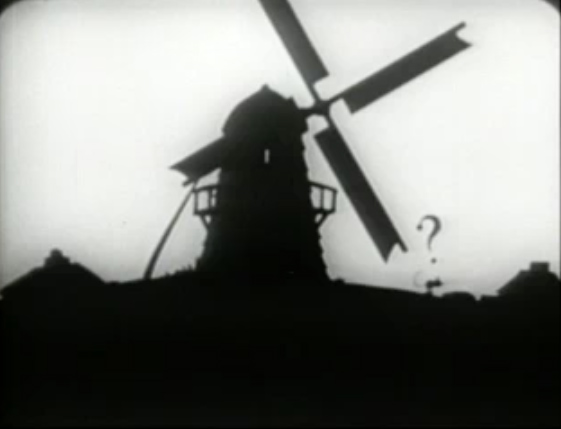
A Pat Sullivan Comic
Dir.: Otto Messmer
TC4P Rating: 6/9

 As a child growing up in Alaska throughout the late '60s and through the '70s, I am certainly too young to have watched the series on its initial broadcast, but I also do not recall ever seeing the Felix television series in reruns (at least, not until I was much older and had cable television). If it did run on my local channels at some point, it would have to be due to an astounding slip of my television vigilance, because I watched nearly anything I could (on all four available channels, plus some stray UHF) that lied within the purview of my interests. Animation being one of those interests at the very tippy-top of that list, I could not only practically sniff out cartoons immediately upon turning on the TV set, but even had entire TV guides nearly memorized the day they came out. Unfortunately, while I was aware of Felix as a cultural icon pretty early in my youth – I certainly had friends with dolls, clocks and puzzles emblazoned with his smiling image – it wasn't until my mid-teens that I caught a collection of early silent cartoons on PBS where I finally got to see what all the hubbub was about concerning Felix the Cat.
 I do not know if Felix the Ghost Breaker was one of those first shorts that I viewed; honestly, there wereonly a couple of Felix films inside a wide mix of other silent shorts, and the only one that I truly remember by title is Winsor McCay's original Gertie the Dinosaur. But since Felix the Ghost Breaker's plot falls neatly into the realm of horror-related material in time for the Halloween season, it is the short with which I am kicking off my long-delayed return to active cartoon blogging after a nearly 3-year break. Felix the Cat just celebrated his 100 anniversary as a cultural icon last November, and while I am a tad late in celebrating him myself, he seemed the perfect subject for this very moment.
 The short was produced for the second batch of Felix silents (1922-1925), which were produced by Margaret J. Winkler. She was a key figure in silent animation history, aiding not just the rise of Felix to superstardom status, but also helping to forge the early careers of the Fleischer Brothers and Walt Disney. While Felix was initially created in 1919 and his early films distributed by Paramount Pictures, Pat Sullivan signed a deal with Winkler in 1922, bringing animator/director Otto Messmer with him. (There has long been a dispute over who the real creator of Felix is: Messmer or Sullivan. Most animation historians of any sort of decent repute tend to side with Messmer. I have no reputation, though I am far from decent, so I will not weigh in with my opinion, as I really don't have enough information.)
 Felix the Ghost Breaker is actually fairly Felix light as far as his true involvement in the story goes. Though he is a constant presence throughout the picture, Felix mostly stands about and acts shocked at things for much of the cartoon, and really only springs to action in the final third. The true star of the picture is a spookily obnoxious "ghost" who first haunts a cemetery, then a barn, and then finally a house in short order within the story. Now, there is a big problem regarding the ghostly hijinks in this short, but we will get down to discussing that issue later in this piece. First, let's rip through the plotline bit by bit...
 At the outset of the story, it is a dark but not at all stormy night. Felix, wandering alone through the evening, decides to take refuge inside a cemetery for a good night's sleep. Felix walks up to a comfortable looking grave, and with the help of a handy word balloon straight out of a comic strip, informs we viewers, irony fully intact, "That's what I call an ideal resting place!" He curls up beneath a tombstone and falls fast asleep. However, a ghost has a different idea and decides to start taunting our hero cat. First, he employs an unearthly (I presume, since the film is silent) "Oooh"-ing sound. The sound awakens the cat, who then attempts to regain his snooze, but the sound emits from the tombstone again and again.

 With the third iteration of the sound, a pair of white-clad hands spring from around the tombstone, and Felix is up and on the alert. Shaking his head and breaking the fourth wall again, he tells us, "I must have been dreaming!" He again lies back down, but the "Oooh"-ing sound continues, and he pops up again, this time seeing a large hand extend straight upward from the top of the grave marker. He again tells us, "I must have been dreaming!" but before he can even consider lying down again, a sheet-style ghost pops up behind the tombstone, looks left and then looks right with dramatic arm flourishes, and then glares at Felix and points down at the grave. Felix shakes in fear, and the ghost momentarily disappears.
 Cut to the spook sneaking up tip-toe style on the open door of a barn. Before the ghost even makes it to the door, Felix likewise is tip-toeing up behind the ghost. After the spooks floats through the door, a long "EEEEEEEEE!!!" emits from someone or something unseen inside. The sound carries to the nearby farmhouse, where a light comes alive on the second floor, and the once-sleeping farmer sticks his head out the window to find out what is making that ungodly noise. After looking about, he peers with great surprise in the direction of the barn, where the action cuts to show the farmer's donkey streaking out the barn followed by the ghost. The donkey stops and quakes with fear while the ghost taunts and points at the animal. The poor equine rears up to attempt a powerful kick at the ghost, but the spook disappears, and then uses the same trick it played on Felix by reappearing behind the donkey, frightening it anew. The spirit then sternly gestures for the donkey to run for the hills, and the terrified creature does just that.
 The ghost heads towards the house and disappears through the wall. Felix tries to follow the terrible spook, but owing to Felix's inherent corporeality, he merely splats face-first into the wall and then rolls backward. Felix regains his composure and scurries up the porch to peer through the window of the bedroom upstairs. He sees the farmer being terrified by the ghost, who repeatedly points with a stiff arm to tell the farmer to leave the premises. The farmer pulls a gun on the spirit, but it doesn't work to scare it away. The poltergeist then attempts to hypnotize the farmer, but it seems to wear off quickly, so then we see four pairs of ghostly eyeballs floating about at the end of his bed. The farmer leaps for the telephone. "Help!" he cries into the phone, "Send the reserves! There's a ghost in the house!"
 Shortly thereafter, a small truck arrives and pulls up in front of the farmhouse. The back doors burst open and roughly four dozen "reserve" members (or cops, clearly) pour out in succession – in the manner of a clown car in a circus – and race through the front door of the house. Felix awaits the results from outside as the sounds of a furious battle begin to be heard from inside. Much yelling and screaming and even gunshots are described to us via words popping up on the screen. The house then flashes almost psychedelically and the stripes of the flashes spin around the house like a merry-go-round (though the house remains stationary). Finally a large hole is torn open on the roof. One by one, each cop comes somersaulting from out of the hole, and then each bounces on the ground and subsequently lands inside the small truck. The vehicle get wider and fatter as it fills up with the defeated reserve members; then, with all the cops collected, the truck speeds off the way it originally came.
 With the cops on their way, the last one to be kicked out through roof hole to land on the ground is the poor farmer. He turns to Felix and cries, "I'm ruined! The place is haunted!" Felix gestures for the farmer to not worry, and says, "Leave it to me! I'm a regular ghost-breaker!" He sneaks inside and moves into a room, where at least a half dozen spooks creep past a doorway. When Felix decides to move toward that door, a pair of massive eyeballs appear in midair and stare at the cat, swirling about once or twice. Felix tries to back away and leave, but the ghost appears behind him and points for him to leave. Felix turns and the ghost is suddenly in front of him again in that direction. He turns again and four ghosts confront him; one more turn, and the number is a full dozen. They converge upon him in a tight circle but then the whole group suddenly disappears. Felix, with his eyes still closed, throws several punches in the air, but then realizes he is all alone. He acts tough and determined, but then a large hand pops up through the floor and pulls his tail, sending him running for the door.
 In the next room, he stops and arches his back normal-cat style and hisses. He sets himself back to two-foot mode and stands there thinking, but a hole opens up on the wall behind him. The ghost is seen leering at him, and then reaches out to pull the switch on a lamp and send the room into utter darkness. The ghost flies out and attacks Felix. There is a tussle but Felix gets away into the dark. The ghost floats forward toward the screen and points menacingly at the filmgoers in the audience. With the ghost moving away, Felix turns the lamp back on but is frightened by a large skeleton standing just outside the range of the lamplight. Felix jumps up and knocks off the lampshade and the whole room erupts into brilliant light, rendering the skeleton insubstantial.
 Felix tries to think of a plan, saying "I wonder how I can trap him?" and then he hits upon a solid idea, perfectly suited for an era then roughly chest-deep in the dryness of Prohibition. (Alcohol gags are fairly prevalent in 1920s cartoons.) After pacing for a quick bit, he notices a bottle of booze on the table. Knowing his audience exceedingly well, the cat says, "They all fall for this!" The ghost reappears and smell the booze in Felix's hand. After a closeup shot revealing that it is indeed a bottle of rum, it becomes Felix's turn to do the taunting as he runs away with the ghost in fast pursuit, greedily grasping for the bottle. Felix then pulls a gun on the spook, ordering it to put its hands up in the air. The farmer rushes forward and pulls the sheet off of the ghost, revealing the cretinous human inside. The old farmer is shocked at the revelation and yells, "Trying to frighten me into selling, eh? I'll fix you!" Jabbing two fingers into his mouth, the farmer whistles loudly for his donkey. The long-eared creature eagerly runs up, rears his hind legs back, and kicks the ex-ghost all the way towards the moon on the horizon! And thusly, the film ends.
 Now, while one should not expect too much coherence from a cartoon clearly built to excite the then-fairly wide-eyed filmgoing audience (in relative terms compared to today... and not just kids, either) with the surreal notion of talking cats and havoc-wringing ghosts, I have some definite issues with the film. Most noticeable is the reveal of the "ghost" to be a normal human, a move I almost always despise in almost any form of storytelling. While I personally don't believe in the notion of ghosts as conceived in popular terms, I don't like it when a story that is meant to invoke a fantastical setting at its beginning degrades into normal reality by its end. One can invoke the case of Scooby-Doo's mysteries, which nearly always end in the same manner, and while I did (and do) love the show as a nostalgic presence in my life, it always rankled me that the monsters and spooks were never "real". However, both Scooby-Doo and this Felix short do end with the same fantastical premise as a base: that a talking, intensely anthropomorphized four-legged mammal is the star at the center of the action.
 The second sticking point for me is the ultra-late reveal that the human in guise as the spirit is using his charade to try to scare the farmer into selling his property. Again, it's a cartoon short from the silent era and no one is expecting the plot to be carefully laid out in such a way. And also, once again, this is an echo instantly bringing up a recall of Scooby-Doo. It is becoming increasingly clear that this short is practically a template for the mysteries of Scooby-Doo (while most certainly not the earliest example of such a plot).
 And the third – and most noticeable – sticking point is the actions of the ghost itself. At least on Scooby-Doo, there was a short explanation by the Mystery Machine kids of how the perpetrator achieved some of his effects. For example: "He used these buckets to make this sound" or "This film projector created the illusion that he was going through the walls" or "He had this rope tied about him to make it look like he was flying by employing this hidden pulley system" etc. (Even though nobody ever saw a big thick hunk of rope dangling through the air at the time... but enough on that...) Here, the ghost is seen flying about the property of the farm in mid-air, disappearing and reappearing, going through walls, appearing as four sets of disembodied eyes, as a pair of giant eyeballs, coming up through the floor, and reappearing as four, six, and then twelve separate ghosts. And also as an entity that is capable of beating the snot out of four dozen armed police officers, causing them to flee. One guy. In a sheet. Neither the farmer or Felix thinks to ask, "How the hell did you do all of that?"

Hmmm... this gives me an idea. Maybe this is a good way to get that house that I wanted... real cheap...
Happy (early) Halloween! See ya soon with the next 'toon!
RTJ