Little Dutch Plate (A Max Fleischer Color Classic, 1934)
 Dir.: Dave Fleischer
Animators: Willard Bowsky; Dave Tendlar
Cel Bloc Rating: 6/9
One of the most cherished books of my childhood was a collection of short stories written and illustrated by Johnny Gruelle, creator of Raggedy Ann and Andy. Now, the famous dolls only appear in the book as characters in a section on the ABCs; most of the book is dedicated to stories about bears, fairy wonderlands and toys come to life. I am really hard pressed to tell you the title of the collection, for I do not actually possess the copy, as the book resides with my mother back home in Anchorage, and the reason that I have such a hard time recalling the title is that I have never actually seen the true front cover of the book. I believe that the cover was severely damaged in my infancy, and thus a new cover was sewn onto the book.


 But the cover and title are not important here; what is important to know is that the book held a variety of whimsically designed ducks inside its covers. Toy wooden ducks and "real" ducks (though drawn), all with squat little bodies and wide, smiling bills. Gruelle obviously knew exactly how charmingly he could portray them, because the book is full of them. And the charm worked on me.
 The second Max Fleischer Color Classic, Little Dutch Mill has a Gruelle-like duck as a supporting prescence in its story, and if the film had concentrated more on this character, I might be more inclined to like the film. As it is, like Poor Cinderella before it, so much has been concentrated on design and wowing the audience visually, that very little attention was paid in the story department. The story in a cupboard? Precisely a story in a cupboard, for that is where this film begins, as various cups are hung inside of the cupboard, as a woman's voice sings of the little dutch plate that forms the centerpiece of the collection. The song is an exceedingly successful song from 1934 (popularized by Bing Crosby), which tells of the love that a little Dutch boy and a little Dutch girl have for each other. The song, as it exists in this cartoon, goes:
"Far across the sea in Holland
in the land of wooden shoes,
there's a story
nearly everyone knows
and I'll tell you how it goes...!
In a little Dutch mill
on a little Dutch hill..."


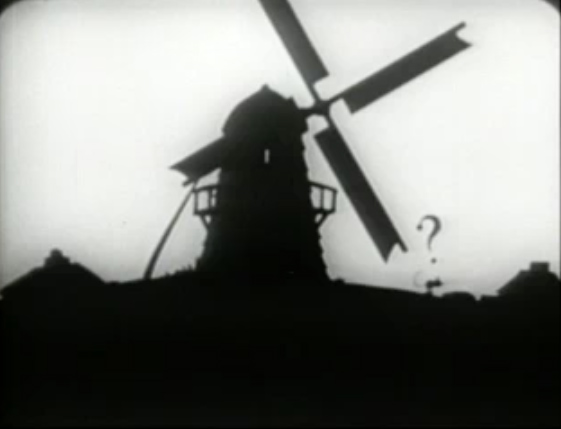
 The story shifts to the mill depicted on the plate, whose frame and blades are torn and spent from years of neglect, while a little Dutch girl, a little Dutch boy, and the aforementioned charming duck cavort about in circles, dancing their cares away and la-la-la-ing the next couple lines of the stanza. (The song's lyrics pretty much disappear at this point.) As the music continues, through a wonderfully expansive stroll along the street, we see the inhabitants of this happy place working hard at their daily chores, all in time to the song. Milkmaids, butter churners, a cart-pulling dachshund, and an incongruously placed shoeshine boy (who doesn't shine the wooden shoes; he shaves them down and repaints them -- this is clever; the racial profiling, however, is not). If this were a Disney flick, every one of the citizens would be whistling while they work.
 But, one person, had he been given the chance, would definitely not be whistling: a mean ol' scraggly miser, who shouts about his hatred of humanity and stomps through the swamps barefoot and crushes flowers with a growl and a sneer. Such is his depravity that he poses as a blind beggar, collects a coin from an unsuspecting passerby, and then dismisses the coin as so much junk. His guise is that of an old Betty Boop cretin, and it seems he is always two steps away from breaking into a Cab Calloway shuffle. (One keeps waiting for the jazz band to kick into high gear and start playing.) In his own mumbled though grouchily musical verbiage, he sings:
 "I hate all neat-and-cleans!!
I'm dirty, and I'm mean!!
It turns out that he is the owner of the little Dutch mill, and he scowls menacingly at the playing (though cowering) children as he passes. When he slams and locks the door, he pulls a huge bag of gold out of a hidden chamber, pours it out on a table and chants:
"Jingle! Jingle! Glittering gold!
Precious power and strength unfold!
Reap it! Keep it! Hold it well!
Bold as blood, as life itself!"


 So, after establishing that he is a financial conservative disguised in the clothes of a social liberal, the miser is disturbed by the children, who are peeking through his window and see his secret stash of glittering gold. He dives out at them and chases the Goody-Two-Wooden-Shoes around and around his mill. He finally catches the children and drags them inside of the mill. The clock tower bells chime 6 o'clock, and all of the children in the village go home, kicking their wooden shoes off on the stoops to their houses. We are then presented with a chilling, three-dimensional panning shot of the row of houses, and all of the delightful pairs of wooden shoes neat and in their places, with the camera finally resting on the pair of shoeless homes, side by side, naturally, where the kidnapped children live. The mothers simultaneously discover this intrusion of horror on their normally happy lives, and soon enough, panic is set loose on the streets.
 Meanwhile, the villain stokes his fire, making sure that his iron is red hot so that he may burn the tongues out of the kids, merely to ensure that they can't give away his miserly secret. The brats are tied securely to a post, though their charming little duck is not. He attacks the villain, but this only succeeds in getting his little feathery butt kicked out of the mill. As successes go, this is a major one for the kids, as it allows the duck to go and warn the populace of the whereabouts of the children. While the people don't understand him at first, the duck finally manages to make them follow him to the ramshackle mill. The people smash in the door without hesitation, free the children, and take hold of the mean ol' miser for good!

Apparently, prison is not a harsh enough treatment for someone of his temperament and predilection for stealing, kidnapping and attempted murder. No, they have to resort to a far worse punishment: conformity. They throw the villain in a bath, clip his nails, cut his hair and comb it, shave his face, and outfit him in costumed finery. Women scrub the walls of the mill to reveal long dusted-over wallpaper; they curtain his windows with bloomers and beat the rugs to reveal Persian splendors. The miser struggles through all of this torturous cleansing, but when he at last stands revealed before a mirror, he is surprised to find that he likes what he sees.


And he also likes what he sees in the little Dutch mill that day, too - a marvelously languorous 3D shot of the interior of the mill is shown, without any animated characters, just the prop furniture and detailed walls and balconies. (And the Grinch's heart grew three sizes that day!) The once miserly hoarder discovers true happiness, and gives his gold out to the populace. Finally, the kids (with the swell duck) take to dancing about the mill again, whereupon the camera pulls out to reveal the plate sitting in the cupboard, and the final strains of the song close the picture just as the doors to the cupboard are likewise closed.

And how scary is the concept that only by being part of the group can one find instant and true happiness? I know conformity was a big thing in the ’30s. There was a depression on and the country, is was thought, needed to have everyone as cheerful in their despair as possible; to pull itself up by the bootstraps and carry on until good times returned. Elsewhere, and nearer to Holland, the decade would eventually lead to the rise of Nazism, in which an entire country, via propaganda, was forced to think alike and those that were different were murdered, or subjugated to mental and physical imprisonment, starvation, and torture, and then murdered. It also led to the rise of its American opposite, the Greatest Generation, in which an entire country was convinced to think alike, via propaganda, and rise up and destroy those same Nazis. What was done to stop the fiends during World War II had to be done in the manner used, but according to a movie like this, all those dirty Nazis needed was a good scrubbing.
 I'm not defending the kidnapper and would-be child torturer in this film; I'm just defending his right to be left alone to his miserly misery. The kids are obviously trespassing on his property, and then invade his privacy, and will obviously tell the populace of his hidden wealth. I admit, his violent reaction goes waaaaaayyyyyy too far, but in his head, the miser is merely protecting himself and his property. So, you don't want to fix up your place and buy new clothes? That's his choice as a human. So, he's dirty and unbathed and loaded with cash? Same deal. And who doesn't wish that they were as thrifty as he? Since when is it a crime to hoard money in one's home? And he's grouchy and mean and hates all humanity? That's no crime as long as you don't act out against another person. Unfortunately for the miser, he does act against them. But to be forced to look and think and act like the rest of the town? Total strangers invade your home against your will and remodel it into what they think a proper and accepted home should look like? Thought (and active) crimes just as bad as his transgressions against the little Dutch kids. The miser has lost his freedom of expression.
 We look askance at people like the Unabomber or Charles Manson, and consider them to be mad and insane. There is no denying that they are mad; but somewhere deep at the root of their insane rantings, there was once probably a small kernel of truth that formed a basis for their sincere concerns over our society, before they took that kernel and ran with it to Crazy-Murderer-Land. We recoil with fear over Muslim fundamentalists and think their concerns crazy of the highest degree, because they don't jibe with what is considered the "normal" worldview, even as each and every one of our "acceptable" religions (in white American parlance) have equally whack-job concepts (and equally beneficial aspects) lining their allegedly "holy" texts, and just as much (and most likely more) murder has been done in the name of Jesus Christ than anything else in the last 2,000 years. And, even in the current personal realm of inanities, if you don't watch American Idol, salivate over the National Football League, or celebrate Easter, you are looked at by your co-workers as a monster from hell.
Apparently, it's alright to think differently, as long as you are thinking differently the same way as everyone else. We're all Bwian!!!
Well, I’m not Bwian, er, Brian! I'm a charming, Johnny Gruelle-drawn duck. Quack!!!
RTJ
*****
And in case you haven't seen it...