
 Spooks (Ub Iwerks, 1931)
Director: Ub Iwerks
Music: Carl W. Stalling
Cel Bloc Rating: 7/9
So, what do you do in 1979 when you don't have a VCR yet, and a special comes on HBO with an incredible band that drives you nuts? You take your portable audiocassette recorder, hold the handheld microphone (yes) as steady as you can against the single television speaker and hope to heck that your brother doesn't talk while you are recording it. What was "it"? A comedy special, the name of which I could not remember for the longest time, but research has led me to find that the special was called George Segal's "Best Bets". Since I lost the audiotape recording in the early '90's, the special itself is mostly out of my memory.
 But I do recall five details very well. The special was split between comedy and music acts, and it had a stand-up comedian on it named Jeff Altman (who would go on to star that same year in a spectacular failure of a primetime variety hour on NBC called Pink Lady and Jeff) and it also featured a comedy troupe called the War Babies. I thought both Altman and War Babies were hilarious on the show, but I was only 15 and literally laughing at everything. For all I can remember, what I found so knee-slapping back then would probably be met by me with stone silence and the swelling onset of loudly chirping crickets were I to view it today. Who knows? The other three details involve the music on the special. The first two involve the songs that were played by a punkish rock band: a song called Louise, partially sung in French, and an amphetamine version of the Beach Boys' classic California Girls, with the lyrics transposed to explain the travails of dating girls from the various planets of our solar system and why girls from the Sunshine State kick their asses. (I personally, for my own fetishistic designs, will always go for a girl from Neptune, who possesses a dozen arms and legs and three heads.) The final detail is that, through these two songs, I was introduced to a band called Oingo Boingo.
 I think of Oingo Boingo whenever I watch older cartoons with their images of rampant spookiness and ambling, dancing skeletons. Disney's The Skeleton Dance, in particular, but there are several others that bring me that Boingo feeling, including numerous Betty Boop shorts with their Cab Calloway songs and lurking monsters. Much of this connection stems from the fact that brothers Richard and Danny Elfman used a lot of old cartoon footage in their stage productions and in the film The Forbidden Zone, and also because Oingo Boingo seemed to be a band which at all times found itself surrounded by images of skeletons and haunted house madness. And Danny Elfman, with his turns as the composer and singing voice for Tim Burton's stop-motion skeleton musicals The Nightmare Before Christmas and The Corpse Bride, has done nothing to dissuade this continued connection to the ghoulish and reanimated.
 It is absolutely no surprise then that my thoughts drift yet again to that favorite silly band of my teenage years (and really, I'm still hooked on them to this day) when I watch Ub Iwerks' Flip the Frog skeleton opus Spooks from 1931. The film rushes straight into a wonderfully evocative opening section, featuring the stormiest of dark and stormy nights ever beheld, as Flip the Frog struggles mightily to stay atop his skinnier-than-an-empty-feedbag horse. The wind keeps threatening to blow him off his mount, and the lightning crashes violently all about the pair as they make their way to a rickety shelter. No sooner are they under the structure than it blows away, but they are happy to see that they are only about thirty feet away from a shadow-engulfed house swaying before them in the hurricane winds. They struggle to march through the storm to the front porch, but reach it they do.
 Flip knocks on the door, and we see the creepy silhouette of a sinister figure through the backlit window blind, his hands hanging downward like clawed things as it laughs maniacally. Flip does not notice the figure, and with all the fiery panache of Larry Fine, turns to the horse and calmly orders him to "Shut up." The door opens, seemingly of its own accord, but Flip enters anyway. Once inside, there is the sudden flash of lightning, and behind him, the door slams shut. Standing beside it is a skeleton dressed as a mutton-chopped butler. Flip jumps in shock, the lightning flashes again and the lights go out. Flip runs through the darkened house, until he screeches to a halt in a room where a skeleton wearing a top hat sits at a table in front of two plates, apparently waiting for another party to join him. Flip tries to flee the room, but the skeleton barks at him to stop, and then politely bids him to sit down. Flip sits down on a chair, and the thing gallops Flip over to the plate opposite the skeleton. "You're just in time to dine!", the skeleton announces, and it clangs a bell loudly for service.
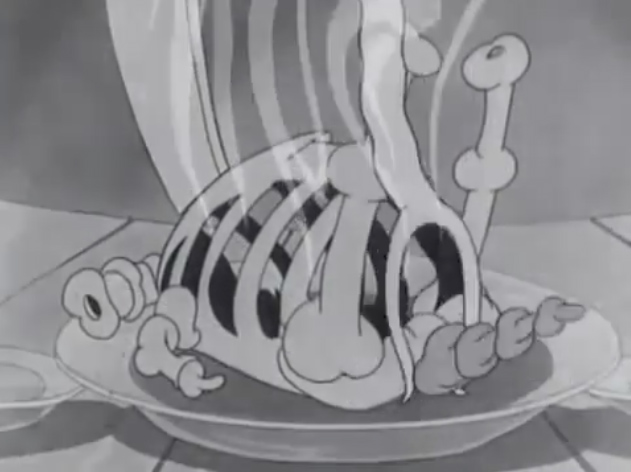
 The mutton-chopped butler reappears bearing a serving tray. He removes the lid, and Flip is treated to the sight of a steaming, succulent... uh, defleshed chicken carcass. The tailbone swipes back and forth of its own accord, and the host skeleton traps it with a fork and carves it off. He places it on Flip's plate, but the frog cheekily tells the host, "I don't like dark meat!" The host instead hands Flip a leg bone (which would still constitute dark meat, I might point out), and an angered Flip pretends to gnaw on the bone. Luckily for him, into the room walks a skeleton dog, who pauses in the doorframe for a sniff, and then, in a great Iwerks gag, lifts his leg as if to mark his territory, but then swings the leg all the way around to his neck to scratch at a flea. Surprisingly, there is a flea -- the skeleton of a flea pops out of the dog's neck and scuttles off across the floor. The dog smells the cooked chicken bones and makes his way eagerly to the table. (Somehow, it still has a tongue.)
 Flip distracts the host and gives the legbone to the dog. Then Flip pretends to be chewing and swallowing the bone when the host turns back around. The host happily gives his guest another legbone, but the trick doesn't work this time, for the host turns around before Flip can fully hand off the bone to the dog. Flip has to pretend that the dog snatched it from him, but after a brief tug-of-war, Flip graciously offers the bone to the host. The host is overjoyed at this kindness, and chows down happily on the meal. The shards of bone from his mastication, however, fall through his ribcage and onto his chair between his thighs. (This is actually somewhat of an eerily revolting sight.) The skeleton has an easy fix for this, though, and simply hangs a small bucket beneath his ribs to catch the shards from his next bite.
 Of course, it wouldn't be right for a cartoon done by Ub Iwerks to involve the presence of skeletons without adding in a swell musical interlude. A skeleton jazz trio thumps out a swell beat on bass, fiddle and piano, and a well-dressed skeleton lady steps across the floor to ask Flip to dance. Well-mannered amphibian that he is (at least, in this scene), Flip acquiesces to her request, and they hit the dance floor. A couple of times in their dance, Flip runs his fingers across her ribs like a xylophone, and she acts like a tickled schoolgirl, pushing him away as though he were a cad. They dance some more, and when they spin, Flip ends up dancing only with her separated top half, with the bottom following behind them. The second time it occurs, he ends up with her empty pelvic socket at eye level, as the torso dances off by itself. Pulling the ol' girl back together, Flip steps back to take a balletic leap into the lady's outstretched arms, but his crash only succeeds in shattering her into a heap of bones on the floor of the house.
 The host skeleton laughs, but his facial expression betrays his ill intentions. (The evilly clutched hands rubbing together probably have something to do with this impression as well.) For whatever reason, the host has four display cases in a trophy room, and only three of them have skeletons inserted into them. The fourth is just exactly Flip's height, but the host pulls out a tape measure to sell the concept to us. Distracting the frog, the host points to a nearby cuckoo clock to remind Flip of the time. The cuckoo skeleton that pops out has trouble making its famous sound, but it spits out a plug of tobacco, and then cuckoos twice to signify the early hour. Flip yawns and stretches, but as he does so, his clothes magically turn into bedclothes, and a candleholder appears in his hand. He follows the host to some stairs, and as Flip climbs them, the host continues to check his measurements gleefully.
 In the comfy-looking bedroom, Flip checks frantically under the bed for something, and the host is confused by this action. Flip whispers his problem to the host, and the skeleton points down the hall to the bathroom. (Love that Iwerks!) A sign on a wall points to the door, reading "This is IT!" If Flip even thought about "IT" for a second, he wouldn't go in the room; but, enter it he does, and his candle gets blown out immediately, and the skeleton sets upon him in the darkness!
There is much crashing about and fireworks, and when the lights come on, Flip is tied down to a table in a laboratory, and the host is hungrily testing the sharpness of a giant knife. Dissatisfied with the blade, he thrashes it on a strap a few times, but as he does, Flip flips the table over and runs off on all fours, with the table riding on his back. The skeleton host gives chase, but when Flip hits the stairs, he somersaults down, the ropes come loose, and he ends up riding the table like a toboggan down the bumpy steps. On the floor, he crashes through one, two, three skeleton guards, and then slides to seeming safety out the front door and onto the back of his faithfully waiting horse. He thumbs his nose triumphantly behind him, but the horse turns into a skeleton beneath him. Surprised, but no fool, Flip leaps off the horse's back and runs over a hill to escape the picture. Iris out.
 I have heard some people compare this to Iwerks' earlier Disney classic The Skeleton Dance, from 1929. Sure, I guess it's reminiscent -- but only because they both have skeletons in them! The musical-and-dance sequence lasts a paltry 80 seconds out of an eight-minute running time, and the plot of Spooks, such as it is, is several steps more evolved than the basic "skeletons arise, dance, and then go back to the grave at sunrise" set-up. This is not a knock on the Disney film; no, not at all. It is a justly acclaimed classic and a highly important step in animation history. I'm merely pointing out that this later Iwerks film has nothing to do with the other film, except that it is Iwerks taking another crack at a film within the same genre. And doing it remarkably well... and fun.
 I can't pretend to know of the Elfman brothers' influences and where they found the inspiration for the skeleton motif that runs through many of their projects, but I will take a guess that they received much of that notion from multiple viewings of cartoons just like Spooks and The Skeleton Dance and similar films. If they weren't influenced by these films, then the dots that I am connecting must have moved in from separate coloring books. But I can't hear a song like Dead Man's Party without thinking, even briefly, about Ub Iwerks' crazily life-like dancing, music-making, singing and even scheming skeletons.
 I also won't pretend that the Oingo Boingo skeleton motif led me to my fascination with horror movies and books; I was already there by that point, I just merely needed to play catch-up like any teenager does when he discovers fun or shocking new worlds to discover. It is a game of catch-up that I have played my entire life, and will continue to play. Just as with the likely effect such movies and cartoons had on the Elfman boys growing up, and as with any person, I am merely a Frankenstein's monster patched together from the influences and experiences of my youth. If seeing The Skeleton Dance at an early age led me to eventually to further exploration of the fields macabre, and if seeing Spooks for the first time as a teenager, at roughly the same time that I first happened upon Oingo Boingo, helped solidify that fascination, then so be it.
As James Burke would point out, our lives, and indeed, all of history, are marked by "connections". Some would call them "coincidences" and some would point to "fate" and "destiny". All I know is that I enjoy animations with skeletons in them, and whether it is from a fleeting connection with a beloved band from my youth or from a prepubescent viewing of an Ub Iwerks cartoon, one cannot surmise.
All I know is that I dig 'dem bones...


