Pages

Showing posts with label Pat Sullivan. Show all posts

Friday, May 12, 2006

Neptune Nonsense (1936)

Neptune Nonsense (A Van Beuren Studios Rainbow Parade cartoon, 1936) 
Directors: Burt Gillett and Tom Palmer
TC4P Rating: 5/9

Fish, outside of halibut, have nothing to fear from me. I've gone through my "keeping fish as a pet" phase, having inherited, through some means of indistinct origin, an unbelievably huge fish tank in the mid-1980s, and mainly through my own lack of interest, except in my strangely personable plecostomus, Quint, it soon became quite apparent that fish were not for me. I am solidly a cat-and-dog guy, which I also owned, and once poor foot-long Quint died (though certainly not from malnutrition, as he made quite a run through my goldfish and various other species) after a few years, I quickly shed myself of the tank and all of its trappings.

As for the devouring of fishy flesh, it is also not for me (outside of halibut). Fish sticks are too bland and weird; salmon disgusts me (I have spent much of my life avoiding it in two households devoted to it, though smoked salmon has its charms); and while breaded catfish is okay, there are too many other things at Cajun restaurants that I am interested in to ever consider the ordering of such an item. I am fairly devoted in my lack of seafood interest (outside of halibut), and if there is a section on the menu with fish dishes in it, I am almost 100% unlikely to even cast it the slightest glance. So, whether for companionship or dinner, fish can stay in their original water for all I care. (Except sharks. I love sharks.) 

But such is not the case with Felix the Cat in the second cartoon of his Van Beuren "comeback" attempt from 1936, Neptune Nonsense. Felix has a lonely pet goldfish, and Felix goes to extreme lengths to bring his sweet little baby some piscine happiness. However, the Van Beuren staff rather fails to bring any real life to Felix, and after the trio of films (which also included The Goose that Laid the Golden Egg and Bold King Cole, both reviewed on this site), it would be a couple decades before the magical cat was allowed another shot at success, only the next time, it would be on television.

In a room encased by near-total darkness, we hear a buoyant whistling rendition of Pop Goes the Weasel, as a shadowy figure, which one must surmise can only be sunny little Felix, moves across the room and springs up a window shade. Brilliant light fills the room of Felix's home, and he wastes not a second in removing the cover from his birdcage. "Good morning!" he chimes to his pair of lovebirds, and after feeding them, he skips, still whistling, across the room to a pair of terriers asleep on a rug (in the way that terriers actually don't sleep in the morning -- believe me). "Good morning!" he shouts cheerfully to the yawning pups, but they have not one bit of compulsion to arise from their mat. Felix's famous exclamation-point tail flashes briefly while he considers the situation, and snapping his fingers, he arrives at a solution. He pulls a dog biscuit out of a box, and saying "Good morning!" again, he waves the tempting object before their eyes. The dogs, much like mine would, immediately jump up and wrestle over ownership of the biscuit. With each dog tugging on an end, Felix fixes the problem by cutting the biscuit in half with some scissors.

In the next room, Felix awakens his goldfish Annabelle with the same greeting. He shakes her breakfast into her bowl, but she is listless and droopy-eyed. He asks, "What's the matter, Annabelle? Don't you feel well?" and she shakes her head sadly, "No." "Aren't you happy?" he follows up, and her answer is a clone of her first reply. Felix paces and thinks, in that clenched-behind-the-back, furrowed-brow way for which he was famous at one time, and arrives finally at the reason. He tells her that she is lonesome, and that he will go out and find her "a little playmate,” a statement which has Annabelle jumping high out of her bowl with joy and anticipation. Felix carries his pet fish outside, but as he walks merrily with her bowl, he trips on a rock, and the bowl, water and fish all go flying up out of his grasp. He scurries and catches first the bowl, then he runs forward to retrieve the falling mass of water, and then runs further still to allow Annabelle to plop back in her bowl. Her rescue is accomplished at the very spot to which Felix was bringing her: a cliff beside the ocean, where Felix conveniently has already placed a fishing pole and apples for bait.

Felix baits his hook and throws his line into the ocean, and almost immediately, with the impatiently wriggling Annabelle looking on from her bowl, he pulls a fish out of the ocean and swings him straight into the bowl. The problem? The slightly larger fish chases and then swallows Annabelle whole, and Felix has to squeeze his little pet out of its throat as if he were handling a tube of toothpaste. Rest assured, the fish is thrown back, and Felix gives it another try. The second apple attracts the attention of a small goldfish much like Annabelle, but the fish is wary of the bobbing prize. A sawfish, however, bigger and armed with a schnoz-equipped weapon, can afford a little more curiosity. It peels the apple with a few deft strokes, and then puts its mouth about the tempting fruit. Felix tugs on the line, the sawfish tugs back, and after a brief war, Felix is pulled into the ocean and down to the bottom. He loses his pole as the sawfish swims away, but he soon spies an entire school of goldfish. He grabs one, but it is too slippery and small to hang onto, and it flees swiftly away.

An octopus policeman with glowing eyes turns them red and whistles fish traffic to a stop, then turns about, his eyes now glowing green, and whistles the school of goldfish through his intersection. One of the fish gets caught in his hand, smiles at him, and zips after his fellows. Felix arrives to ask him if he has seen any goldfish "come this way." The octo-cop mimics Felix's questions in a mocking fashion, and then tells him, in a much higher pitch of voice, that he has seen "some go this way (points right), and that way (points left), and this way!!" He then tickles a delighted Felix, though the octo-cop goes back to being a stern officer of the law once Felix departs the scene. Meanwhile, the goldfish school has run smack into the open mouth of a large sleeping grouper, and when the enormous fish breathes out again, each fish returns encased in their own individual bubbles, which pop as the fish continue to swim. Felix's arrival causes the grouper to awaken, and after Felix asks his question about the goldfish, the grouper spits out a huge bubble which floats casually over to Felix. It pops in a huge burst, and a very waterlogged "No!" is spat at the cat, knocking him down.

Felix spies the goldfish ahead, and just as he is about to grab his quarry, another slightly larger fish zips in and eats the goldfish. Then another fish slightly larger than the previous one swallows that fish, and then yet another slightly larger one follows suit, and then another, and finally, a huge blue-backed fish completes the food chain, and swims contentedly away from Felix. As the sawfish swims past, Felix grabs him by the tail, and when the sawfish grabs a nearby piece of coral with his fins, Felix propels the fish as if he were an arrow in a crossbow. The sawfish flies sharply into the keister of the blue-backed fish, and then each fish is spat up by each succeeding fish in the chain. The fish all turn around to swim away from the tiny little goldfish who started the chain, but he opens up his maw larger and larger as he swims to each fish and swallows them all whole. Bloated like Eric Cartman on a Snacky Cake bender, the now-titanic goldfish floats up to Felix and burps loudly. Later, after an electric eel finishes tormenting a lobster and a starfish, sending them reeling and spinning with jolts from his charge, Felix wanders into the area, and the eel wastes no time in shocking the feline. Felix's insides light up, and in the process, light up the whole ocean floor, before Felix runs off to resume his search elsewhere.

The goldfish, playing child-like with a bubble, is finally discovered by Felix. When the cat grabs him, the fish cries for "Help! Help!" and the entire ocean community rushes to his aid. The citizenry of the sea all begin chanting, "Help! Police! Kidnap!" and "Murder!" and other additional crimes. A beat cop manages to get on the shell-o-phone and reaches his dispatcher, who sends out the call to the squadron. "Calling all carps! Calling all carps!" (Many fish cartoons seem to love this gag, up to and including television’s Fish Police.) The call is repeated inside what comprises a fish paddy wagon: a frightening deep-sea monstrosity with enormous needle-sharp fangs, with a carp riding along on its side while listening through a back-mounted horn. Everyone gives chase after poor Felix, and he is finally tracked down and dog-piled by the carps. They throw him in the paddy wagon and wheel him away towards the forbidding gates of King Neptune's castle.

Neptune is busy charming a small beautiful mermaid (with prominent and clearly naked breasts, which she jiggles as she dances, but they are sans the nipples that would apparently make her "nude" -- nowadays, they would place little off-flesh-colored dots over the nipples, like they do on the mainstream newsstand men's magazines, as if to say "Hey, sorry, boys! No nipples here! Just little dots - shaped exactly like nipples."). King Neptune plays Aloha Oe (Farewell To Thee) on the tines of his trident, and the mermaid giggles and dances, spins and swims in circles, and kisses Neptune on the cheek over and over. (One wonders why he ever bothers with looking at the fish.)

But, all good things must eventually end, and Neptune has a court over which to preside. After banging his gavel harshly on a table, the King of the Oceans hears the charges from the goldfish regarding Felix the Cat. "He tried to kidnap me! And cook me! And eat me!" the fish lies (except for the obvious first part). Neptune is outraged, and Felix, clearly the victim of species profiling, is not allowed to plead his defense. "How would you like to be put in a hot frying pan, and cooked until you were nice and brown--?" Neptune asks the cat, "-- On both sides! How would you like to be somebody's dinner? How would you like to be MY dinner!" 

When Felix states that he doesn't eat fish, the King laughs with disbelief. Felix tells the King that he was only trying to give the little guy a nice home, but the victimized goldfish protests that he already has one. However, the little nipper has an idea, which he whispers into the King's ear. Neptune picks Felix up and carries him to a fish orphanage, where Neptune picks out a cute little goldie for Felix and Annabelle. After the remaining orphans give them a sendoff, Neptune brings them back to the shore, where he places the orphan into the bowl with Annabelle. "Bless you, my children!" the cheerful ruler declares, "Good luck and goodbye!" He approximates an awkward dive back into the water, and Felix is left with his two charges. "Now are you happy, Annabelle?" Felix asks the ladyfish, as she smooches her new boyfriend intently. She emits two bubbles from her mouth, which rise to the surface of the water, and pop: "And how!" The fish kiss again, and the film irises out.

Here is the problem with the Van Beuren Felix shorts: Felix is not allowed to be Felix. In each film, he is surrounded by other, bigger characters, and each time, the directors allow Felix to get swallowed up by the events surrounding him. Felix is not allowed, except in brief instances in each film, to do what he does best: think his way out of situations. It's thrilling in the early part of this film to see Felix's tail turn into an exclamation point, as it did nearly every cartoon in the silent days, but then he never uses it for anything, especially to get himself out of jams or try to catch the fish. Felix is too passive in this film in particular. Once he hits the water, he is mainly at the mercy of whatever gag situation he wanders into, and the Felix of old would have found a way out of Neptune's court. This Felix allows all of the other characters to determine his fate, something silent Felix rarely did. Not enough thinking and pacing makes Felix a very dull kitty. Not that the animation of the cat isn't swell, but he really doesn't do very much in this series to warrant such grand design.

Last night, as I was watching this cartoon in preparation for this post, I was at the moment of Neptune's trident rendition of the Hawaiian Aloha Oe song, when I received a call from Jen, just off work, who told me that a friend of ours from Hawaii, Ali, was in town for the night, and wanted to catch up with us at Disneyland. Coincidence? I think not, especially where cartoons are concerned. Once we finally got there, we grabbed a table at the Uva Bar in Downtown Disney, and ordered some tapas while we awaited Ali's arrival. For several days, I had been craving, for some weird probably-Food Network-related reason, fish n' chips (something I rarely do), and I took the opportunity at seeing it on the Uva menu to order a plate. To my horror, though the chips were great, the fish was bland, slimy and highly unpalatable, and I had to douse it in malt vinegar and tartar sauce (which I wanted to save for my chips, for I am all about condiment variety as far as chips are concerned) to get the stuff down.

It was then that I realized that what I had been craving all along was halibut n' chips, which is a commonality in my Alaskan home, but rare indeed in Southern California. Compared to my delicious halibut, the ocean-dweller I had been devouring with my Ali-reunion meal might as well have crawled out of a cesspool. It didn't put a damper on a fun evening, but I came to realize just how picky I am when it comes to my associations with the creatures of the sea, even when its choice seems to be called for by hint of coincidence regarding the playing of a Hawaiian ballad, the viewing of an ocean-visiting cartoon, and the receiving of a phone call from a dear friend.

I wouldn't mind scoring that hot mermaid, though... nipple dots or no nipple dots.

RTJ

[This piece was edited and revised with new photos on September 15, 2016.]

Friday, March 03, 2006

Felix Finds Out (1924)

Felix Finds Out (A Pat Sullivan Comic, 1924, silent) 
Dir.: Otto Messmer
TC4P Rating: 7/9

An extremely impatient narrative, Felix Finds Out, released in 1924, seems to have committed to no certain plotline for the bulk of its length. It meanders here and there with only the slightest connection between its imaginative sections; it is only at the end does one realize that a) there is a purpose and goal in mind, and b) the film is, in essence, a shaggy dog story, and that the purpose and goal in mind is to get to a single punchline or concept, and that everything else that comes before it is just hay. This, of course, wins it a spot in my heart, which has an entire wing devoted to such trifles, including many stories and productions of my own, constructed in exactly the same freewheeling, ambling fashion.

Some would point at the film and its walking hot dogs, drunkenly personable moon, and human-like cat with the extremely prehensile and utilitarian tail, and describe the whole affair as being "surreal". This word is bandied out quite frequently, especially these days, when everything above and including standing on one's tippy-toes during urination is labeled "X-Treme"; similarly, it seems any random bit of weirdness is described as "surreal", as in "Wow, dude, that was surreal!" And they would be, generally, wrong in most circumstances. Merely weird or odd is not necessarily surreal, and as such, this film is not necessarily surreal. It never approaches the dreamlike state of which most surrealism is composed (at least, until the drinking scenes); while the film seems oddly contrived to fit three separate sections together, there is a common line of sense, mentioned through title cards representing the character's dialogue, that flows throughout the thing; and the switches between scenes are not that jarring as juxtapositions. There is a slight feeling of the film being composed of non-sequiturs, but by film's end, you realize that the filmmakers knew exactly where they were going and how they were going to get there. The true narrative path is actually just a slightly erratic line with a few charming bits of oddness thrown into the mix.

A kid named Willie is worried about completing his lessons in time for the school bell, but pal Felix the Cat discovers a nickel while Willie is busy studying. Willie decides they should buy a hot dog with the nickel. Felix is hungry (as usual) and agrees with him, and they run off to the hot dog stand. Once they spend their money, Willie at first refuses to share but then flips a coin to decide who gets the snack. The coin lands on its edge, so they decide to split it 50-50. The hot dog, laying on the ground during the proceedings, will have none of it. The hot dog barks loudly, stands up (who knew that they had thin little legs and feet, let alone that they could bark?), dances a hasty jig, bows to his pair of would-be devourers, and runs back to the hot dog stand from whence he came. He jumps back up on the counter and lays back down with his fellow hot dogs. (At this rate, the cart owner is never going to run out of supplies, but he is also never going to make a dime.)

Felix initiates a plan to capture all of the hot dogs by behaving in exactly the sort of way he never does: like an actual cat would. Felix lowers himself to the regular standards of his species and meows loudly and then struts in front of the hot dogs, who begin to growl and then give chase to Felix. Our hero runs into a doghouse, with the hot dogs fast on his trail, and they go in after him. A terrific though unseen battle takes place, and then Felix motions Willie to step into the doghouse. The two of them come out of the shelter with their happy stomachs full of the vanquished hot dogs.

The school bell then rings, and Willie suddenly realizes that he is in trouble for failing to learn his lessons. Once in class, however, Felix tries to help his pal out with his mathematics problems by sitting on the window sill and forming the answers with his amazingly talented tail. Luckily, both answers are of the single digit variety, so that Felix doesn't have to stretch his powers too much; unluckily, the teacher catches on to their little racket rather quickly. Because of this, Willie is given a tough homework assignment to do that evening. It turns out to be this question: "What makes the moon shine?" Finally, we understand the title of the film: Felix has to find out the answer to this question.

That evening, Felix goes to ask the Man in the Moon about the answer. The Moon is angry about being disturbed, and he frightens Felix at first when he moves in closer to the cat, but lightens up instantly because he is actually a jolly sort. Felix asks him what makes the moon shine, but the Moon only winks and laughs at him. Felix punches the Moon right in the nose, and the Moon drifts back up into the sky. Frustrated, Felix leans against a dead tree to ponder the question further;, but the tree begins to walk away! Felix follows the tree across the field, until the tree stops at a shack with a sign that reads "Try Our Moonshine". The tree knocks a branch on the wall, and then a window appears with a shady looking character in it. The tree asks for something with a dancing motion, and as the first window shuts and a second lower one opens, the man inside the tree costume pulls off his disguise and then ties it around his waist like an apron. He is clearly a bartender, and from out of the bottom window arrives a jug of moonshine. He picks up and kisses the jug, and then runs off.

Felix tries this same thing and is rewarded in the exact same way. He takes a swig from the jug, and almost instantly becomes drunk. He staggers and hiccups, and then a strange-looking, worm-like dragon briefly appears in his view. He takes another shot from the jug and is plagued by dots in his vision, and then the dragon reappears even larger and scarier than before. Felix takes several phantom blows at his non-existent opponent, but then something even weirder shows up: a large elephant (it would be pink, I presume, had the film been produced in color) with wings, and flashing, alternating stripes and dots. Felix tries to fight this aberration of nature, too, but the winged pachyderm disappears. He then staggers back to Willie's window, where the worried kid is still awaiting an answer to his homework. He asks Felix if he found out what makes the moon shine, and Felix responds, "Did I? I'll say I did!" He laughs uproariously, and the film irises out.

Silliness, but slyly innovative silliness from the early days of the cinema. It's amazing how much freedom Otto Messmer had with the character of Felix, who could prove to be most pliable to just about any situation in which they put him. There is no attempt in many of these films to affix any sort of coherent storyline to his adventures; mainly, situations are given simply so that the cat can pace and then think his way out of them. This is the true face of Felix the Cat, without a voice, and without a gimmicky magic bag of tricks; just a plucky cat with a sharp brain and an adaptable tail. (Why he needed a bag of tricks when he already had the tail is beyond me; I find the tail far more intriguing.) Cartoonists have tried to jam a lot more into some far less compelling characters. Felix, a major star already within the very adolescence of the American cinema, had everything you really needed…

RTJ


[This piece was edited and revised with new photos on September 15, 2016.]

Wednesday, March 01, 2006

Two-Lip Time (1926)

Two-Lip Time (Pat Sullivan, 1926, silent) 
Dir.: Otto Messmer
Cel Bloc Rating: 7/9

My cat Buster Keaton Ghidorah doesn't think. At least, he doesn't think like Felix the Cat. He doesn't pace back and forth, hands clenched together behind his lower back, scowling as if to scare that elusive strand of thought out from under the cupboard in his brain. My cat also doesn't have a tail that detaches from his body and forms a big black question mark whenever he sees something that draws his curiosity, or that can turn into any number of helpful tools whenever he needs a way out of a pinch. He also doesn't walk in a bipedal fashion like Felix, which would prove to be an unnerving sight if he were actually able to do that for even a stretch of three feet.

Lastly, he is not silent like Felix: he talks and talks and talks... and loudly! I remember a few years back where there was a glorious run of about two days after he was trapped out of the house (due to his own quick bolt as I was leaving; he was an outdoor cat, so I didn't think anything of it)... and couldn't meow, couldn't purr, couldn't squeak... for a blessedly low-key and pin-dropping quiet and sweet two days after my return. He would do his normal routine, but either something scared him or whatever, but he was my little quiet Felix for two wonderful days. When he did return to his boisterous yowling, demanding ways, it was in small increments, and so, the entire week was nearly silent in that regard.

Buster still didn't think like Felix either, even after that wake up call, though someone did plan and pull off the Great Post-Thanksgiving Refrigerator Robbery of 2001, in which every leftover given to me from three different households ended up down the gullets of both my cat and my equally sized dog, Blip Ignatz Mice. Either they worked in tandem to get that door open, or one of them had been planning that caper, but perhaps it was the delicious smell of all of that wonderful turkey, mashed potatoes and stuffing that drove them to do such a crime. (I know that I'm that way about mashed potatoes too.) So, maybe he did pace back and forth on his hind legs, slouched and scowling, tail shaping into a lightbulb of discovery, and then finally unleashing his master break-in of the fridge.

Felix is definitely hungry at the start of Two-Lip Time, one of his adventures from 1926, but he is not seen thinking his way through the problem. Instead he is on a dock in a harbor, hot on the trail of his potential dinner victim: a tiny mouse. The mouse runs off on a rope leading to a massive ocean liner, and Felix follows suit. The problem comes when a sailor undoes the rope just after the pair run into the ship, and the liner takes to the open sea. Felix doesn't notice until the mouse disappears down a hole in the floor, and suddenly our hero realizes where he is: two portholes show the sloshing waves of the sea and the tilt of the ship's axis, and poor Felix slowly becomes seasick. He tries to concentrate on catching the now unseen mouse, but his stomach yearns for something else, and eventually he can no longer keep what few contents reside within intact anymore. He runs to the porthole, hangs his head out and throws up into the ocean. (We don’t actually see him throw up, of course; it is implied by the heaving of his body out of the porthole.)

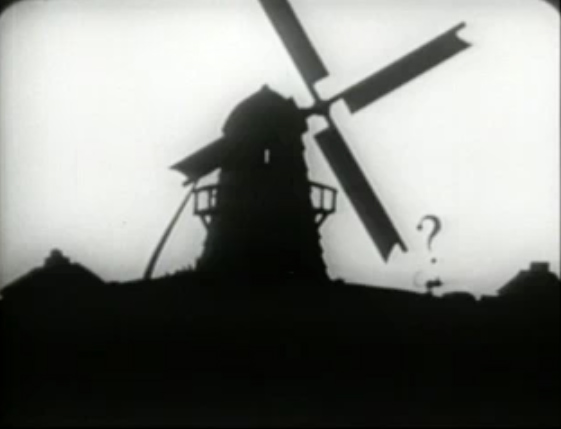
A title card tells us that Felix is suddenly "IN DUTCH", and sure enough, the boat pulls into a port in Holland, with a horizon dotted with windmills, and with a couple dozen of the citizenry there to greet the unseen passengers on the liner. Felix takes in the strange surroundings, and then espies a cute little Dutch girl, complete with the stereotypical clogs, and swiftly forgets his stomach hunger and starts a new kind of craving. He instantly falls in love with the girl, and leaps from the porthole to join the girl on the ground. He asks if she would walk with him, and she agrees in kind. As they walk, Felix flirts with her and eventually kisses her. Unfortunately for the Cat, she has a little Dutch suitor, who shows his jealousy by confronting Felix and attacking him. Felix runs to a nearby car and retrieves a tire pump from it. He runs back to the boy and pumps air into his pants, turning the boy's bottom half into a balloon that rises into the clouds and carries Felix's rival away.

Felix then pulls out a banjo and makes to serenade his new beloved, but his strangled mewling wakes up a man who is asleep on the porch nearby house. The man is most decidedly not happy about this, and his wooden shoe at the Cat. As the man threatens to give chase to Felix, our hero uses the shoe as a boat, taking to a nearby river and turning an exclamation point over his head into a makeshift paddle. Felix stops rowing and looks back to check the man's progress, but the boat continues on without him, and he has to run on the air to catch up with it. He eventually finds safety on the other shore, swearing off the whole situation, including, apparently, his love for the girl.

In a nearby yard, Felix comes across a bottle of gin sitting on a table. He smells the liquor and finds it not to his liking, but then spies a bottle of milk enticing him from the sill of the house adjacent to him. After Felix makes an unsuccessful attempt to steal the milk, a man appears in the window, and Felix begs for the bottle. The man tells him that if Felix would water the flowers in the garden (tulips, naturally), then Felix will get the bottle of milk. The man departs, and Felix tips the table backwards so that the gin in the bottle pours into a conveniently placed water-can. He then profusely "waters" the tulips, and the little buds come to life instantly. One tulip even drinks the gin that forms into a pool on the ground; then all of the now besotted flowers beg for more of the precious "water". Felix then pours the gin onto the base of a tree, which instantly begins to act drunkenly, and then staggers and stumbles its way offscreen.

The man, meanwhile, has caught on to Felix's antics, and chases the cat through the countryside. They first spin round and round on one windmill, and then the man chases Felix to a second one. Here, Felix climbs to the very top, and then detaches his tail to use it as a hand-crank. He spins the blades of the windmill ever faster, until the entire thing is spinning like an enormous fan. A hurricane-strength wind arises from Felix's cranking, and his nemesis is blown out of sight. Felix puts his tail back on, looks at the camera, and laughs heartily to finish the picture.

I like the fact that the title has a double meaning in its use of "Two-Lip", and the details on individual characters are incredibly vivid. (The sequence of the man removing his shoe has a depth to its design that is quite astonishing for a film from the early days of animation.) The shipboard sickness scene does go on a little too long, but the starkness of the room combined with the two portholes with the sloshing seawater is a most memorable image. Felix has a swell character bit, where, after he has dumped the gin and is about to water the flowers, he does a silly straightening and flourish to his whiskers. I also like the fact that once Felix gets to Holland, he completely forgets his hunger, only rediscovering it once he has given up on the girl, and then sees the bottle of milk. Love can make you forget you are starving to death, I suppose.

Of course, he never does get to down anything in the cartoon, and this is where he definitely differs from my cat. I attribute this to Felix's silence: no matter how loud Felix yells in these films, they are silent movies, and he is going about the process all wrong. My cat, on the other hand, CAN'T... SHUT... UP...! The slightest twinge of hunger gets him yowling, and the only way to tone him down is to feed him. NOW!

If only it were possible to distract him with a little Dutch girl...

[This article was updated with new photos and edited on 11/23/2015.]

Sunday, February 26, 2006

Bold King Cole (1936)

Bold King Cole (A Van Beuren Rainbow Parade cartoon, 1936)
Dir: Burt Gillett
TC4P Rating: 6/9

I am struck by how many people I know who get Felix the Cat – the star of silent animated films, bad TV series, and endless merchandising – and the alliteratively similar but decidedly far more, er, sexually obsessed Fritz the Cat confused with one another. 

Surely it is the "F" at the start of their five letter first names and the fact that they are both "the Cats" that cause the initial mental switch-up. But many times in the past I have been confronted by normally sane people who ask me, straight-faced, "Which one is in that movie? The animated one?" Of course, there is no truly clear answer to such a question, unless you take "that movie" to mean “the feature film,” since most people tend not to think of what they would consider a mere cartoon (and thus simple child’s play) as a “movie”. They are wrong, of course… a film of any length is still a movie, no matter its content or its intent of distribution or lack thereof. But, naturally (because you are dealing with idiots), you have to respond "Oh, that's Fritz the Cat". Those same persons, invariably, have generally not actually seen Ralph Bakshi's film of Fritz the Cat (and even less have read R. Crumb's original comix) any more than they have actually seen a silent Felix the Cat. Most have tended to merely know good ol’ Fritzie from his film's reputation as a dirty, dirty movie. 

As for Felix, who can still be found all over the place on T-shirts and mugs and clocks and what have you, even in the 21st century, it almost seems as if many people are not even aware that Felix was ever actually in theatrical cartoons, so little are they seen these days. Even though the original “the Cat” has somehow remained a popular cultural figure since his creation, some people can't get his name right. Or mixed up with a different cartoon cat that likes to get wasted and have lots of sex with loose animal girls of various species with robust figures.

An attempt in the mid-1930s was made by the Van Beuren studios and directors Burt Gillett and Tom Palmer to revive the character of Felix in their Rainbow Parade series (sort of like Disney’s Silly Symphonies, Warner’s Merrie Melodies, MGM’s Happy Harmonies, or Fleischer’s Color Classics, only by Van Beuren instead; every studio that wanted to be a major player in animation had to have a color series like this at a certain point.). As Felix had previously been a silent figure, and since, apparently, dialogue just had to be assigned to the Cat, Felix was affixed with a not unpleasant but rather unmemorable voice filled with golly-gee, can-do boldness. 

At the beginning of the last of the three Van Beuren Felix shorts, Bold King Cole, the Cat is also possessed of a sassy tenor croon, which he accompanies with guitar whilst hanging in a tree, singing about Nature and Me, surrounded by the flowering buds and chirping birds of the forest. Then a lightning storm shatters the serenity, and, of course, the lightning focuses in poor little Felix. The lightning bolts shoot and jab him repeatedly; one bolt even lights his head up like a 40-watt bulb, complete with element (an effect which, it turns out, he can switch on and off with his nose, and does, through the remainder of the picture). The bolts eventually chase him out of the forest and to the seeming shelter of a nearby castle. It is a jarring but charming opening; in fact, the first couple minutes of this cartoon are quite memorable, and if the remainder of the film had retained this early sense of wonder, it would have been terrific. Instead, it becomes monotonous and silly in the worst way, which is truly unfortunate given the fact that the film is populated by fanciful notions of ghosts and their ilk.

The castle is inhabited by the frightened retinue of an equally timid but boldly boastful monarch, Old King Cole of nursery rhyme fame. But there is no pipe nor bowl nor fiddlers three in this tale; rather, Cole is an insufferable braggart who shouts loudly of his bravery to all who will hear, but in his heart he is as much of a chicken as the rest of his subjects. Felix bangs frantically on the castle door to gain entrance and relief from the attacking storm, and the King has to answer the door as no one else will. So the monarch seizes the opportunity to prove how tough he is to a total stranger. He quickly descends upon the rescued Felix with a flurry of loudmouthed boasts, but the ghosts of the figures in the castle's paintings are sick and tired of hearing his Royal Longwindedness and set out to do something to stop him. 

The ghosts capture the king in the dungeon and torturously pump the hot air out of him, all the while singing a song with the refrain, "You talk too much, you talk too much". They then force him to listen to his own voice to teach him a lesson. Felix sees that the lightning storm has continued unabated, and formulates a plan to save the king from the ghosts. He uses the arms of a suit of armor to attract and funnel an array of lightning bolts into the dungeon, destroying the ghosts for good. The king pumps his own hot air back into his frame, and acts satisfied at the return of his plumpness. Felix and Cole laugh and sing about how they are "not afraid of anything,” but then a pair of mice, for no apparent reason, decide to manipulate and stage a battle between two suits of armor, causing the "heroes" to hide in fear. The mice complete their melee and call a truce, and the King and Felix come out of hiding. The King crowns the cat "Prince Felix" and switches his nose to turn on the lightbulb effect. Felix does the same to Old King Cole, and they laugh as the picture closes.

I like the lightbulb idea, but I wish they had put it to some good use throughout the picture. I especially like some of the bits in the opening lightning storm, such as when a bolt saws through a cloud like a knife through a loaf of bread and unleashes a torrent of rain upon the Cat. I also like it when a bolt hits the back of the tree that Felix is sitting in, and the tree jumps like a startled man kicked or poked in the seat of his pants. Much like the same year's The Goose that Laid the Golden Egg, there is an epic feel to the backgrounds and direction that the story itself doesn't bother to carry off, and we are left yet again with a wistful sense of "what could have been" had the story department been stronger in their support of a character sorely in need of better development.

At least Felix gets made a prince at the end of the story. Luckily for him, this film was made in 1936, almost forty years before the Bakshi cat movie, so the King doesn't mix up the names and declare him "Prince Fritz". Then Felix would have no choice but to go and hump one or both of the battling mice, the ghosts would have an orgy with the castle residents, and the King would really have something new to brag about...

Now that I think about it, this might have been the direction Van Beuren should have taken. Ah, what could have been... they could have beaten Hefner and Flynt to the punch.

RTJ

[This piece was edited and revised with new photos on September 13, 2016.]