Frankenstein's Cat (1942)
Dir.: Mannie Davis
TC4P Rating: 7/9
Frankenstein's Cat almost backs into the shockingly high rating that I finally granted it on IMDb, and thus across the board on my various sites. (Believe, I too am shocked.) By no means the most accomplished film in the Terrytoons pantheon, this early entry in the frustratingly inconsistent Mighty Mouse series – surprisingly, only the second one out of eighty films the first incarnation of the super-powered rodent made – gets by in a strong way by having a certain intangible that makes even a common film rise above the muck for me: Halloween.
 The film does not take place at Halloween, mind you. In fact, it is mentioned by the narrator early in Frankenstein's Cat that the action in the film takes place on "a warm midsummer's day". But Frankenstein's Cat is laden so heavily with dark atmosphere, horror film imagery, and monstrous action that it should be included automatically in any Halloween aficionado's collection of holiday-themed animation highlights. The film ends up being a delight for almost exactly the opposite reasons it may have been intended but still remains true to its source of inspiration: the Universal monster movies that were still currently in production at the same time this cartoon was released.
 In a post last month in my set of reviews written in conjunction with my "shark film" theme for September, I discussed the eighth Mighty Mouse cartoon, The Wreck of the Hesperus, and the basic timeline of the series up to that point. No need to go into the entire thing again [you can read that review here], so to make it brief, it seemed that the filmmakers were desperate to find a common starting point for the series. Mighty Mouse was indeed an inspired choice for a parody of a popular comic book hero who had himself just broken through on the big screen via Max and Dave Fleischer's wonderful efforts (their Superman cartoon series is still a high point of non-cutesy animal animation to this day), but it should have also proved a good starting point for their own series.
 Two problems: 1) Terrytoons really did not commit to a solid personality for the mouse, changing his temperament, look, costume, and even origin from film to film early on in the series; and 2) they couldn't even commit to his name. They called him Super Mouse for the first seven films in the series, but had changed it to Mighty Mouse by the time The Wreck of the Hesperus rolled over the waves. [In reviewing this cartoon, it is a cut TV print without the original titles and there is an obvious voiceover (with a different tone) that announces Mighty Mouse's presence instead of Super Mouse's when his big reveal occurs.]
 In the very first Super Mouse cartoon, The Mouse of Tomorrow (also 1942), the diminutive hero is brought to life by an ordinary mouse who is inside a "super"-market seeing a predicament that needed to be solved, by bathing in "super"-soap, and indulging heavily in "super"-cheese, "super"-soup, and "super"-celery. It is not odd that a creature commonly considered a pest of our pantries and warehouse stores would find his powers by devouring human food resources, nor that he would be aided in gaining such powers due to being exposed by marketing hyperbole. (It's actually a nice touch that last part, though it doesn't come off as being an intentional thought.)

 But here in Frankenstein's Cat, released just five to six weeks later and deep into November 1942 (missing the Halloween season completely), while it is still the eating of cheese that turns him into a superhero, it is a particular type of cheese (more on this later). In the third film, He Dood It Again, he still lives in the supermarket, in a giant mouse hole in the side of the building, and is Super Mouse the entire time, though he is only in portions of the film. In the fourth film, Pandora's Box, he takes a series of vitamins, leaping from bottles A, B, C, D, E, and XYZ; by the fifth film, Mighty Mouse Rides Again, he sleeps on the side of a star and only awakens when help is needed; and by the sixth, Down with Cats, he is once again Super Mouse the entire time but only shows up when things are their most dire, though he seems to be hanging out nearby. This takes the series one year into its existence, and the Super Mouse character, very close to changing his name for good to Mighty, has remained rather inconstant in origin and powers, and yet somehow the series as a whole is entirely too predictable.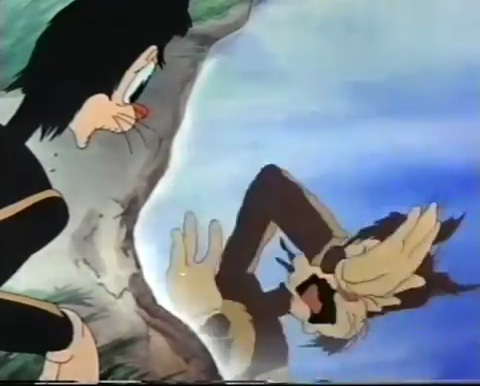

 Super Mouse is both pretty remarkable for his physical prowess but also rather dull for the fact that the outcomes are a given (but this is a failing in general of the superhero genre, at least for that day). It would take later films for the character to become really interesting for me, and truly, it was Ralph Bakshi's late 1980s television revival series that actually made me a Mighty Mouse fan. Not given a lot of exposure to early Terrytoons shorts meant that my viewings of the original Mighty Mouse in my youth was pretty limited, including suffering through an annoyingly crafted Filmation series in the late '70s, where he starred alongside Heckle and Jeckle. (And, of course, my obsession with Andy Kaufman's "Foreign Man" lip-syncing of the Mighty Mouse theme on Saturday Night Live in the mid-'70s.)
 The narrator tells us that the mice and birds had gathered on that midsummer day that I spoke of earlier for a celebration. We see mice dancing around a makeshift maypole, and bird flitting from house to house and around the trees joyously, due to have gone an entire year without being disturbed by the presence of a cat. Birds pick up flower after flower, and each one has a mouse inside of it, who rides the flower down to the ground gently as if they were parachutes. Once there, each mouse climbs on the back of his corresponding bird and goes for a joyride. A father canary also picks up his two newly hatched fledglings and takes them for a flight. He drops them off in midair and then swoops below to catch them softly on his back as they tumble head over heels.
 However, for this film to fit the Halloween mold for me, Frankenstein's Cat has to be about more than just happy little mice and birds, and take a genuine turn towards the eerie and the scary. Just over a minute into the film, it does just that. On the canary's second pass through the air, one of his kids tumbles off early and a hard, stray gust of wind picks the little guy up and carries him off in the distance towards a strange, ominous-looking castle on a mountaintop. The baby bird is dropped off on the head of a falcon-style gargoyle that sticks out from a tower wall, where he is immediately surrounded by large, black bats that swoop all about him.
 Atop the castle, we meet the title character. While we never meet the Dr. Frankenstein that created him in this film, we are introduced to a large black and orange tabby walking erect on what appear to be mechanically engineered legs. The narrator sums it up with his line, "What fiend of darkness haunts this place?" The creature ambles about and turns towards us in closeup so we get to see a better view of his body. His limbs are clearly jointed together as if built from an erector set, his torso is round and straight as if he had swallowed a huge cylinder of some sort, his tail seems constructed of several separate knots strung together, and he has long arms that reach down almost to his knees. His walk is staggered due to his mechanical means of locomotion as he patrols the turrets of the castle during the storm gathering over his heads. With the setting perfect for monster mayhem, the narrator shouts, "It's Frankenstein's Cat!" and then the creature indulges in a huge smile as he lifts his arms into the air and is lit up directly by a massive bolt of lightning.
 Soon enough, Frankenstein's Cat notices the little bird stuck out on the gargoyle's head. Like any normal cat, the monster gives up his body to try and take an ill-advised swipe at the baby bird, but the bird is just enough out of the way that he is able to gain just enough control of his flight to veer off unharmed. Having fallen off the castle, Frankenstein's Cat plummets to the ground to its base, and then rises like the living dead (which we must assume he actually is). He shakes his arms upward at the sky and commences with a roar that sounds like a drunken lion. Off to the side of the castle, there is a machine that has a stick with a boot on the end of it. He turns his backside to the boot's toe, and then pulls a cord at the front of the machine, kicking himself in the rear over and over again. ('Twould appear this is not his first time at failure, if he has a machine to remind himself of them...) Following his self-served butt-kicking, the cat stomps away very angry.
 Chasing after the baby bird as it flies awkwardly over the mountain desperate to escape, the angered monster cat shakes his fist in determination. Soon enough, the bird flies to the edge of the pond and just misses getting grabbed, but the cat is suddenly distracted by his own reflection in the water. Seeing himself, the cat becomes very upset at the monstrous face in the water, and screams in agony over his own perceived ugliness. He builds up enough gumption, however, to peek into the water again. This time, his reflection is the one that reacts in disgust and agony, swiping his paws over his eyes to hide himself. This rejection sends Frankenstein's Cat into a manic rampage. He stomps through the line of birdhouses and swats most of them down as he passes. He comes to a final white-and-red birdhouse, peers inside the hole, and then uses an electrical shock from his finger to set the house afire. It burns to a cinder, and it turns out the baby bird was inside, hiding in a bathtub. (Bird bath? Get it?)
 The bird flies towards the mousey side of time, where the rodents see the monster cat coming and flee inside a stump where some of them live. The cat skips reaching through the front door and sticks his arm through the top of the stump, where a series of wooden slats have been used to create a non-exactly weatherproof roof. He fails to grab any mice, but a couple of them push a hot stove over to where the monster's hand is and give their nemesis a scalding burn. He pulls his now pulsing red hand out and uses his supernatural strength to blow it cool instantly, and then figuratively loses his own cool, kicking the stump over in a bully-like fashion. The baby bird flies out of the stump and flees to a nearby tree, where he hides in his parent's nest. The bird puts the pieces of his former egg home together to obscure himself, but the ravenous cat easily finds him and grabs the poor little guy.

 Frankenstein's Cat carries the baby bird back to the castle, while other birds attack the cat from all sides along the way. Reaching the castle gates, the cat pulls the drawbridge closed to block the birds' advance. The mice gather en masse, and in the tradition of any Frankenstein flick, pick up torches and boards with nails embedded in them and charge the castle. Some of them attempt to swim the moat and climb the walls, while the monster throws bricks down at them. When one mouse makes it to the top, Frankenstein's Cat uses his shock power once again to jolt the mouse with electricity. More mice follow, and he jolts each one, their shocked bodies falling into the moat.
 Elsewhere, inside the Super Market that serves as the base of "you know who" early on in the series (one of the few connecting traits in the first few films), a small brown mouse is listening intently over a candlestick phone's receiving device. "Help is needed!" says a staccato voice, much like one would hear on a police radio. "Help is needed! The monster is on the loose again!" The little mouse runs to a huge, mostly intact round of limburger cheese (so marked by a sign) and eats his way through it. The narrator asks, "Can this be the champion of the helpless?" When the mouse bursts through the side of the cheese round, he has turned into... well, Super Mouse, but the print that I have available has Mighty Mouse's name edited in Super Mouse's place. Super... Mighty... whatever the hero's name, you know pretty well he is going to get the job done in less than two minutes because that is how much time is left in the film. And we know this especially because, early in this series, Mighty's costume looks exactly like Superman's, except for the lack of a chest logo.

 Super/Mighty Mouse (we shall go with Mighty Mouse after this) flies through the receiver of the phone and then through the phone cord, his body pulsing up through the wires to the transformer box on the telephone pole where he makes his presence known by crashing out into the open air. The mice and birds see their legendary hero zoom over their heads to the castle and raise their arms, beginning a wild cheer as they do. Frankenstein's Cat sees Mighty Mouse approaching his domain and starts to fret and worry. Mighty Mouse punches straight through the drawbridge of the castle and does battle with each of the big black bats, making short work of them. The monstrous cat charges Mighty with a large butcher's knife in hand, but this does not slow down the hero mouse for a second. No sooner has he hit the last bat than he suddenly has a sword in hand, and he and Frankenstein's Cat begin a furious melee through the halls and up and down the stairs of the castle, worthy of any period swashbuckler.
 Fearing he has lost the butcher-knife-sword-fight, the monster cat ducks into a side room, but the hero mouse follows him. Dust and furniture fly out of the room while an unseen battle commences, and when it is done, we see Frankenstein's Cat bound by ropes to a chair. Mighty stands on a table and, in a tough guy voice standard to the era, tries to get the cat to spill the beans, or bird, as it were. "What didja do wit' da boid?" he asks the cat, and then slaps the monster's now fearful face several times. "So ya won't talk, eh?" Mighty flies briefly back down to the table and turns his x-ray vision on to the cat's midsection. Inside a spotlit area, we see the baby bird sitting on the series of pipes that seems to make up the mechanical cat's ribs. The little guy is holding his hands (wings) together in prayer, and seems to be talking to the heavens.
 Suddenly, the cat struggles against his bonds and breaks free of the ropes and chair. (I am now not sure what it was for which the baby bird was praying.) Frankenstein's Cat shuffles sadly towards the open stone window and four bats fly up and support each of his limbs. They carry the cat out into the sky to make his escape, but Mighty is fast on the monster's tail. He punches the cat in the rear but while the punch is mighty indeed, it does nothing to alter their flight. He flies ahead and circles back towards the monster cat, but the villain breathes fire from his mouth. Mighty Mouse pushes and punches his way up through the column of fire, until at last he pulls the surprised cat's head off of its shoulders and tosses it away. Mighty then flies around the cat's body, still being flown by the bats, and pulls on its stringed tail and lets go. The shockwave of snapping back at the body sets the rest of the cat free of the bats and flailing back down to earth.
 As the cat's beheaded body tumbles through the air, the baby bird flies free of the hole in the cat's neck, but then the inexperienced fledgling begins his own freefall towards the ground. The body of Frankenstein's Cat crashes hard into the crowd a couple of feet from its head. The body sits up and starts to feel around blindly for its head, pops it back in place, and then the rebuilt Frankenstein's Cat throws its arms up into the air and turns tail, running as fast as it can towards the horizon and out of the picture. The baby bird is still tumbling down, however, but he is saved at the last second by a timely swoop from Mighty Mouse. The rodent hero delivers the baby back to his overjoyed, chirping parent. Mighty Mouse is then seen standing with his eyes closed and arms folded as he stands atop a small boulder, with the mice cheering and birds flying all around him. Flowers are thrown in his direction as the narrator (who really had very little to do in this short) sums up the picture by announcing, "Mighty Mouse... the Champion!" THE END.
 Except for never seeing the mad scientist who built him nor the equipment that raised him to life, Frankenstein's Cat is still a nice condensing of a basic Frankenstein or other mad monster film from the '30s and early '40s. The monster has the built-in villain status that any cat seems to have when the victims in the cartoon are mice and/or birds, so its a wise choice in rendering this genre to the animated screen. We get the castle and the torches, we get the monster running amok and not just threatening the "villagers" (mice and birds), but also demolishing their property, and then the frenzied finale to stop the creature. The nicest touch here, though, is in adding just a dash of sympathy for the monster.
 Certainly, Frankenstein's Cat himself is clearly lonely in his castle (I guess his loyal bats aren't too much in the way of conversation), but it is the pond scene where he does battle with his reflection where we, as viewers, are allowed to not just accept this film as just another "Mighty Mouse vs. the big bad cat" film. When he rails against his own visage in the water, we are granted a chance at empathy for this sad possibly misunderstood creature. Yes, his instincts, being at least part cat, are so ingrained he cannot help but go after the little bird (it seems such nutrition will do him little good when his insides are naught but metal piping). However, because of this scene and the cat's very clear displeasure at his own undertakings (the kicking himself in the pants punishment), he is actually given far more emotional depth than we normally get to see in the villain of a six-minute cartoon. It's a touch that is absolutely in concert with the Universal Frankenstein films, at least the original Karloff pictures where, ultimately, the monster really is the hero (this film does not take it quite that far).
 Yeah, I thought that I was crazy, too, liking this film as much as it turns out that I do. On paper and in my head, I much prefer other later Mighty Mouse pictures, but for whatever reason, this one sticks around for me. The use of the castle's environs is really well done, as is the detail, and some of the odd little bits, such as the kicking machine, as well as the empathy angle for the monster, add just the right notes to put this short into repeated Halloween viewing for me. I hope that you take the chance to enjoy Frankenstein's Cat for yourself.
RTJ
*****
And in case you haven't seen it...