Pages

Showing posts with label ghosts. Show all posts

Friday, October 02, 2020

Countdown to Halloween: Felix the Ghost Breaker (1923)

Felix the Ghost-Breaker (1923)
A Pat Sullivan Comic
Dir.: Otto Messmer
TC4P Rating: 6/9

Unlike many people of a similar age to me (that age being now, incredibly to me for a variety of reasons, 56), I do not have early childhood memories, outside of toys and clocks, of Felix the Cat. A great many of my age were introduced (it seems) to the character primarily from the television cartoon series from the late '50s and early '60s (specifically, 1958-1961) in which Felix battled The Professor and other baddies in two-part cliffhanger episodes. 

The giveaway for me when people talk about Felix is when they mention either his voice (done by Jack Mercer, previously of Popeye fame), his theme song ("Felix the Cat/The wonderful, wonderful cat...") or how much they loved his Magic Bag of Tricks. I immediately know they are talking about the television series and not the original run of silent cartoons from Otto Messmer and Pat Sullivan, wherein the Cat originally began his tremendous popularity. It's not that I feel they are "posers" or something along those lines; such thoughts are squarely idiotic. I don't care when you started liking what you purport to like; just take a little time to learn something about the history of whatever it is you like and we will be fine. Such slights of knowledge were more excusable in the pre-internet days, where you either had to run into a stray article in the newspaper or hike it to the local library and do some research to learn anything. Today, any cellphone gives you access to nearly any subject in mere seconds.

As a child growing up in Alaska throughout the late '60s and through the '70s, I am certainly too young to have watched the series on its initial broadcast, but I also do not recall ever seeing the Felix television series in reruns (at least, not until I was much older and had cable television). If it did run on my local channels at some point, it would have to be due to an astounding slip of my television vigilance, because I watched nearly anything I could (on all four available channels, plus some stray UHF) that lied within the purview of my interests. Animation being one of those interests at the very tippy-top of that list, I could not only practically sniff out cartoons immediately upon turning on the TV set, but even had entire TV guides nearly memorized the day they came out. Unfortunately, while I was aware of Felix as a cultural icon pretty early in my youth – I certainly had friends with dolls, clocks and puzzles emblazoned with his smiling image – it wasn't until my mid-teens that I caught a collection of early silent cartoons on PBS where I finally got to see what all the hubbub was about concerning Felix the Cat.

I do not know if Felix the Ghost Breaker was one of those first shorts that I viewed; honestly, there wereonly a couple of Felix films inside a wide mix of other silent shorts, and the only one that I truly remember by title is Winsor McCay's original Gertie the Dinosaur. But since Felix the Ghost Breaker's plot falls neatly into the realm of horror-related material in time for the Halloween season, it is the short with which I am kicking off my long-delayed return to active cartoon blogging after a nearly 3-year break. Felix the Cat just celebrated his 100 anniversary as a cultural icon last November, and while I am a tad late in celebrating him myself, he seemed the perfect subject for this very moment.

The short was produced for the second batch of Felix silents (1922-1925), which were produced by Margaret J. Winkler. She was a key figure in silent animation history, aiding not just the rise of Felix to superstardom status, but also helping to forge the early careers of the Fleischer Brothers and Walt Disney. While Felix was initially created in 1919 and his early films distributed by Paramount Pictures, Pat Sullivan signed a deal with Winkler in 1922, bringing animator/director Otto Messmer with him. (There has long been a dispute over who the real creator of Felix is: Messmer or Sullivan. Most animation historians of any sort of decent repute tend to side with Messmer. I have no reputation, though I am far from decent, so I will not weigh in with my opinion, as I really don't have enough information.)

Felix the Ghost Breaker is actually fairly Felix light as far as his true involvement in the story goes. Though he is a constant presence throughout the picture, Felix mostly stands about and acts shocked at things for much of the cartoon, and really only springs to action in the final third. The true star of the picture is a spookily obnoxious "ghost" who first haunts a cemetery, then a barn, and then finally a house in short order within the story. Now, there is a big problem regarding the ghostly hijinks in this short, but we will get down to discussing that issue later in this piece. First, let's rip through the plotline bit by bit...

At the outset of the story, it is a dark but not at all stormy night. Felix, wandering alone through the evening, decides to take refuge inside a cemetery for a good night's sleep. Felix walks up to a comfortable looking grave, and with the help of a handy word balloon straight out of a comic strip, informs we viewers, irony fully intact, "That's what I call an ideal resting place!" He curls up beneath a tombstone and falls fast asleep. However, a ghost has a different idea and decides to start taunting our hero cat. First, he employs an unearthly (I presume, since the film is silent) "Oooh"-ing sound. The sound awakens the cat, who then attempts to regain his snooze, but the sound emits from the tombstone again and again.


With the third iteration of the sound, a pair of white-clad hands spring from around the tombstone, and Felix is up and on the alert. Shaking his head and breaking the fourth wall again, he tells us, "I must have been dreaming!" He again lies back down, but the "Oooh"-ing sound continues, and he pops up again, this time seeing a large hand extend straight upward from the top of the grave marker. He again tells us, "I must have been dreaming!" but before he can even consider lying down again, a sheet-style ghost pops up behind the tombstone, looks left and then looks right with dramatic arm flourishes, and then glares at Felix and points down at the grave. Felix shakes in fear, and the ghost momentarily disappears.

While the moon looks down wistfully in the distance at the graveyard shenanigans, Felix scans the air where the ghost evaporated. The cat shakes his head, and then twirls his finger near his ear to tell us he must be going crazy, and then laughs wildly. The ghost sneakily pops back up behind Felix and gives him a fright. The cat grabs a large rock to throw at the ghost, but the spook evaporates once more and reappears on the other side of the grave. It sticks its tongue out at the cat and flies off into the night. Felix swears to go after the ghost, telling us, "That ghost is up to some kind of mischief. I'll follow him!!"

Cut to the spook sneaking up tip-toe style on the open door of a barn. Before the ghost even makes it to the door, Felix likewise is tip-toeing up behind the ghost. After the spooks floats through the door, a long "EEEEEEEEE!!!" emits from someone or something unseen inside. The sound carries to the nearby farmhouse, where a light comes alive on the second floor, and the once-sleeping farmer sticks his head out the window to find out what is making that ungodly noise. After looking about, he peers with great surprise in the direction of the barn, where the action cuts to show the farmer's donkey streaking out the barn followed by the ghost. The donkey stops and quakes with fear while the ghost taunts and points at the animal. The poor equine rears up to attempt a powerful kick at the ghost, but the spook disappears, and then uses the same trick it played on Felix by reappearing behind the donkey, frightening it anew. The spirit then sternly gestures for the donkey to run for the hills, and the terrified creature does just that.

The ghost flies back into the barn, with Felix looking on quizzically at what the horrid thing might be seeking out next. His answer comes quickly, as he first hears a squeal of terror, and then a wheelbarrow flies out of the barn, followed by a sow. As she grabs the handles of the barrow, a dozen small piglets flee from the barn and pile up into the cart. The sow turns the barrow and wheels it at the highest speed she can manage towards the horizon. Her speed is so great that she eventually catches up to the donkey who had fled previously.

The ghost heads towards the house and disappears through the wall. Felix tries to follow the terrible spook, but owing to Felix's inherent corporeality, he merely splats face-first into the wall and then rolls backward. Felix regains his composure and scurries up the porch to peer through the window of the bedroom upstairs. He sees the farmer being terrified by the ghost, who repeatedly points with a stiff arm to tell the farmer to leave the premises. The farmer pulls a gun on the spirit, but it doesn't work to scare it away. The poltergeist then attempts to hypnotize the farmer, but it seems to wear off quickly, so then we see four pairs of ghostly eyeballs floating about at the end of his bed. The farmer leaps for the telephone. "Help!" he cries into the phone, "Send the reserves! There's a ghost in the house!"

Shortly thereafter, a small truck arrives and pulls up in front of the farmhouse. The back doors burst open and roughly four dozen "reserve" members (or cops, clearly) pour out in succession – in the manner of a clown car in a circus – and race through the front door of the house. Felix awaits the results from outside as the sounds of a furious battle begin to be heard from inside. Much yelling and screaming and even gunshots are described to us via words popping up on the screen. The house then flashes almost psychedelically and the stripes of the flashes spin around the house like a merry-go-round (though the house remains stationary). Finally a large hole is torn open on the roof. One by one, each cop comes somersaulting from out of the hole, and then each bounces on the ground and subsequently lands inside the small truck. The vehicle get wider and fatter as it fills up with the defeated reserve members; then, with all the cops collected, the truck speeds off the way it originally came.

With the cops on their way, the last one to be kicked out through roof hole to land on the ground is the poor farmer. He turns to Felix and cries, "I'm ruined! The place is haunted!" Felix gestures for the farmer to not worry, and says, "Leave it to me! I'm a regular ghost-breaker!" He sneaks inside and moves into a room, where at least a half dozen spooks creep past a doorway. When Felix decides to move toward that door, a pair of massive eyeballs appear in midair and stare at the cat, swirling about once or twice. Felix tries to back away and leave, but the ghost appears behind him and points for him to leave. Felix turns and the ghost is suddenly in front of him again in that direction. He turns again and four ghosts confront him; one more turn, and the number is a full dozen. They converge upon him in a tight circle but then the whole group suddenly disappears. Felix, with his eyes still closed, throws several punches in the air, but then realizes he is all alone. He acts tough and determined, but then a large hand pops up through the floor and pulls his tail, sending him running for the door.

In the next room, he stops and arches his back normal-cat style and hisses. He sets himself back to two-foot mode and stands there thinking, but a hole opens up on the wall behind him. The ghost is seen leering at him, and then reaches out to pull the switch on a lamp and send the room into utter darkness. The ghost flies out and attacks Felix. There is a tussle but Felix gets away into the dark. The ghost floats forward toward the screen and points menacingly at the filmgoers in the audience. With the ghost moving away, Felix turns the lamp back on but is frightened by a large skeleton standing just outside the range of the lamplight. Felix jumps up and knocks off the lampshade and the whole room erupts into brilliant light, rendering the skeleton insubstantial.

Felix tries to think of a plan, saying "I wonder how I can trap him?" and then he hits upon a solid idea, perfectly suited for an era then roughly chest-deep in the dryness of Prohibition. (Alcohol gags are fairly prevalent in 1920s cartoons.) After pacing for a quick bit, he notices a bottle of booze on the table. Knowing his audience exceedingly well, the cat says, "They all fall for this!" The ghost reappears and smell the booze in Felix's hand. After a closeup shot revealing that it is indeed a bottle of rum, it becomes Felix's turn to do the taunting as he runs away with the ghost in fast pursuit, greedily grasping for the bottle. Felix then pulls a gun on the spook, ordering it to put its hands up in the air. The farmer rushes forward and pulls the sheet off of the ghost, revealing the cretinous human inside. The old farmer is shocked at the revelation and yells, "Trying to frighten me into selling, eh? I'll fix you!" Jabbing two fingers into his mouth, the farmer whistles loudly for his donkey. The long-eared creature eagerly runs up, rears his hind legs back, and kicks the ex-ghost all the way towards the moon on the horizon! And thusly, the film ends.

Now, while one should not expect too much coherence from a cartoon clearly built to excite the then-fairly wide-eyed filmgoing audience (in relative terms compared to today... and not just kids, either) with the surreal notion of talking cats and havoc-wringing ghosts, I have some definite issues with the film. Most noticeable is the reveal of the "ghost" to be a normal human, a move I almost always despise in almost any form of storytelling. While I personally don't believe in the notion of ghosts as conceived in popular terms, I don't like it when a story that is meant to invoke a fantastical setting at its beginning degrades into normal reality by its end. One can invoke the case of Scooby-Doo's mysteries, which nearly always end in the same manner, and while I did (and do) love the show as a nostalgic presence in my life, it always rankled me that the monsters and spooks were never "real". However, both Scooby-Doo and this Felix short do end with the same fantastical premise as a base: that a talking, intensely anthropomorphized four-legged mammal is the star at the center of the action.

The second sticking point for me is the ultra-late reveal that the human in guise as the spirit is using his charade to try to scare the farmer into selling his property. Again, it's a cartoon short from the silent era and no one is expecting the plot to be carefully laid out in such a way. And also, once again, this is an echo instantly bringing up a recall of Scooby-Doo. It is becoming increasingly clear that this short is practically a template for the mysteries of Scooby-Doo (while most certainly not the earliest example of such a plot).

And the third – and most noticeable – sticking point is the actions of the ghost itself. At least on Scooby-Doo, there was a short explanation by the Mystery Machine kids of how the perpetrator achieved some of his effects. For example: "He used these buckets to make this sound" or "This film projector created the illusion that he was going through the walls" or "He had this rope tied about him to make it look like he was flying by employing this hidden pulley system" etc. (Even though nobody ever saw a big thick hunk of rope dangling through the air at the time... but enough on that...) Here, the ghost is seen flying about the property of the farm in mid-air, disappearing and reappearing, going through walls, appearing as four sets of disembodied eyes, as a pair of giant eyeballs, coming up through the floor, and reappearing as four, six, and then twelve separate ghosts. And also as an entity that is capable of beating the snot out of four dozen armed police officers, causing them to flee. One guy. In a sheet. Neither the farmer or Felix thinks to ask, "How the hell did you do all of that?"

That said, I still enjoyed this cartoon very much. It's got decent atmosphere, it is definitely spooky in parts (with the closeup of the ghost approaching the audience especially memorable), and it moves along very swiftly from gag to gag. I am a little disappointed that Felix does not employ his magical tail as a tool or weapon at any point, as he tends to do in many of his early cartoons (and later ones as well, even the TV series). There is even a moment where question marks appear above his head, although in at least one other short I have seen, his tail makes the question mark when he is puzzled. (A missed opportunity...) But Felix's derring-do and need to make things right is definitely in place and the results are still quite fun.

Hmmm... this gives me an idea. Maybe this is a good way to get that house that I wanted... real cheap...

Happy (early) Halloween! See ya soon with the next 'toon!

RTJ

***

And in case you haven't seen it, you can watch the short below...


Thursday, October 19, 2017

Countdown to Halloween: The Ghost Town (1944)

The Ghost Town (Terrytoons, 1944)
Dir.: Mannie Davis
TC4P Rating: 6/9

I first ran into the Terrytoons cartoon team Gandy Goose and Sourpuss sometime before I was ten. Fiddling around with the UHF channels on a whim one day – while also adjusting the rabbit ears on top of the old school black and white television we owned, and yes, those rabbit ears had big tinfoil flags wrapped onto them – I ran across a Heckle and Jeckle cartoon. I had seen one of their cartoons before, so there was nothing remarkable about the discovery except that I had found them in a previously unknown location. I don't even remember which short it was except that they were in a hotel room (I never saw the title at the beginning of the film). Time and overfamiliarity with the characters has wiped away the memory of that scene, but another cartoon came on next featuring Mighty Mouse. It was the one where he fights a big bad wolf (the cartoon is named Wolf! Wolf! in most versions) and saves the mice as he usually does. Once again, I knew who Mighty Mouse was (mostly from comic books), and so apart from the joy of finding a new cartoon to watch, the moment was just what it was.

And then I met Gandy Goose and Sourpuss. The next short was a cartoon in which a goofy looking bird with a large beak and a cranky mostly black cat were dressed as soldiers fighting in World War II. Years later, actually having remembered scenes from it (in a marked difference from the Heckle and Jeckle short), I discovered the title of the cartoon was Scrap for Victory. As I had not seen Disney's version of Alice in Wonderland quite yet (I would see it first in 1974), I did not know who Ed Wynn was yet, so I had no way of connecting Gandy Goose's similar voice to the great comic actor. But Jimmy Durante I did know, and so it was easy to equate him with Sourpuss the Cat's rough, New York accented voice. I thought the cartoon was pretty swell, but then again, I like nearly every cartoon at that age. When the Gandy and Sourpuss cartoon was over, the cartoons went away. The station switched to an old movie that we chose not to watch, and so we switched the TV back to a regular channel.

The reason I remembered Gandy and Sourpuss so vividly over Heckle and Jeckle – even though I like the talking magpies (who look more like crows) a lot more – is because Heckle and Jeckle were a regular part of my youth in my teens, with Filmation producing a new Saturday morning show in which they co-starred with Mighty Mouse. As a result, my memories of H&J were largely built around that show's version of them, while my only memories of the other team were from that single cartoon showing on UHF a few years earlier.

It would be about 15 years between that UHF viewing and my next meeting with Gandy and Sourpuss, when a couple of their shorts would get played on a different UHF channel airing in Anchorage, Alaska (in a studio not far down the road from where I lived too) called The Cartoon Channel, the first such station in the country (predating Cartoon Network by a few years). Most of the cartoons on the station were of the public domain sort, but they did have some sort of Hanna-Barbera package (The Funtastic World of...) that allowed them to show Space Ghost, Frankenstein Jr, the Herculoids, Jonny Quest, and many other HB adventure cartoons, along with the Blue Ribbon versions of many Looney Tunes and Merrie Melodies shorts. In this mix came a handful of Terrytoons, including Gandy and Sourpuss.

Today, I am far more familiar with the pair. While there has never been a major, authorized VHS or DVD release of the Terrytoons catalogue, one can find a wide selection of their cartoons on YouTube. I have more than caught up with the weird goose-and-cat team, and they have become a regular part of my cartoon viewing. I will admit that they are not favorites of my mine; like many later Terrytoons series, I find their cartoons a little too rote and unimaginative for me, and I tire of their recycled antics pretty quickly. That is not to say that every once in a while I might find a cartoon short that has just a little bit extra contained within it, sometimes in rather shocking ways. The Ghost Town, a Gandy Goose and Sourpuss short from 1944, directed by Terrytoons' mainstay Mannie Davis, is one such cartoon.

The credits for The Ghost Town feature a music credit for Terrytoons regular composer Philip A. Scheib, but as xylophones tinkle up and down the scale and the music lurches along, there seems to be a trace of another song in the opening theme. I detect a bit of Mendelssohn's The Hebrides Overture (aka Fingal's Cave) in there, but in a jazzed up, quicker paced way. Of course, when I "detect" it, I do not do so with any massive knowledge of classical music, where I can dip easily into my memory archives and bring up the exact composer and his life history in a moment's notice. What I actually did was say "Oh, that reminds me of... Chuck Jones' Mynah Bird!" (Because I really did, like many people of my generation, learn all about classical music from Looney Tunes and Walt Disney...)

Mendelssohn or not, I really like the opening theme to this cartoon, which informs me right away that I am up for some spooky hijinks. Following the credits, we see some rather odd-looking cacti in a desert. Each cactus has a face, which when combined with a cactus' normal outstretched limbs, lends the plants a rather human quality, like the faces and arms of people who have been frozen in place. The camera tracks across the desert briefly and stops on a small mound, empty at first until what seems like the ghost of a wolf materializes for a quick second or three to howl loudly before disappearing from view.

A male chorus begins to sing on the soundtrack as the camera starts to pan left again, and as they sing, we see cactus after cactus, each one bearing an oddly grimacing human face...

"It's Ghost Town!
It's Ghost Town!
Ghosts are lurking everywhere...!"

The camera leaves the cacti behind to show us the houses of the ghost town. The buildings, like the cacti, also seem to have very human eyes, along with noses and mouths designed and built right into their structure. Traditional "white sheet"-style ghosts fly through the air and in and around the houses as the film and its song continue, with the singers pausing for dramatic effect sometimes between words...

"...Waiting for some
poor, wretched victim
that...
they...
can scare!"

The camera stops at a sign at the front of the town, which consists of a ragged, tattered banner that says "Ghost Town Welcome" strung atop two long poles. A goofy looking, gap-toothed ghost wearing a derby hat flies at the camera and giggles, sticking a finger in each ear and waving the rest of his fingers while he does. The chorus continues with the song...

"In Ghost Town
In Ghost Town
Something's doing every night!
Hear that moaning!
What is that awful groaning?
It's the spooks,
the spooks,
of old Ghost Town!"

As the song concludes, we end up inside of Ghost Town Bar, where we see that the voices of the chorus belong to three beer-drinking ghosts, two of them wearing cowboy hats. The cowboy ghosts are leaning against the saloon bar while a bartender ghost (who is also singing) sways along with them. When the song stops, all four ghosts crane their necks towards the camera and say in unison, "Boo!"

At a nearby pool table, a skeleton is seen readying his next shot. Eyeing the table, he pulls his right leg off his body and uses it as a bridge stick to sink a red ball in the far corner pocket. He pops his leg back into place and walks to the other side of the table. Smacking the cue ball as hard as he can, the skeleton causes all of the balls on the table to clatter and rebound over and over again against each other loudly. Perhaps in recognition of his own abilities, the skeleton turns away from the table immediately after taking his shot, and racks his cue and leaves the room while the balls are still falling into each pocket, including the cue ball.

A rowboat with a single determined ghost bearing oars comes gliding across the room through the air. The chorus (unseen) sing "Row Row Row Your Boat" as he does. At a slot machine, a gentlemanly ghost wearing a fine purple suit, a top hat, and boots with spurs – but with no visible body at all – drops in a coin and pulls the lever. He gets nothing, so tries another coin and pulls again.

There is a wipe upward and the scene changes to a trio of skeletons seated on a bench all looking to the right. Suddenly, they all look straight forward, and then a pair of ghostly hands reach into the frame and pulls the head off the first skeleton. Once the head is removed, the skeletons all reach to their left and pull the head off the next skeleton and place it atop their own bodies. (There is a presumed fourth skeleton offscreen, as the third one is able to replace his head as well...) We then see the ghost standing with the first skeleton's head in his hands as he prepares to use it as a bowling ball. He bowls a strike (unseen) and then reaches over to grab another skeleton head. He bowls again, and this time we see the group of ten long bones that are being used for pins. He clears the pins again, and the head he used as a ball lands on the alley and handily yells, "Strike!"


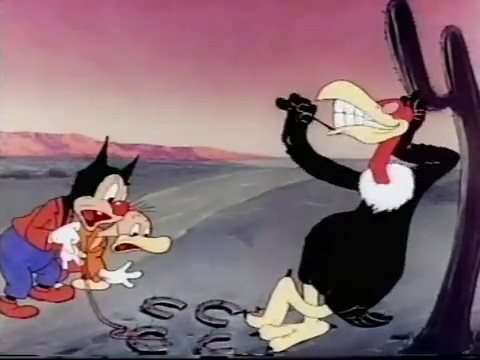
Back out in the desert, from a distance we see two lowly characters riding on horseback. With a closer look, we see the cat Sourpuss and his friend Gandy Goose (who is wearing a giant backpack) looking not all that comfortable while the horse underneath them seems to be on its last legs. The horse's tongue sticks out of his mouth from thirst, and the poor old nag trudges through the desert with very little energy, while ghosts zips under and around its body. Sourpuss says to Gandy, "Listen! How far is this ghost town you're talkin' about? I'm gettin' hungry!" Suddenly, a ghost vulture fades into view on top of the pick strapped onto Gandy's backpack and says, "I'm getting hungry, too!"

Sourpuss and the horse turn to look at the vulture, but Gandy only looks behind himself and doesn't see the ghostly bird. The horse screams a loud whinny, and Sourpuss ends up eye to eye with the vulture. The horse runs away, sending Gandy and the vulture tumbling to the ground, where they too end up eye to eye. The vulture raises his wings in attack and dangles his tongue as Gandy steps backwards to match the carrion eater's approach. But Gandy thinks quickly and pulls out his pick and chases after the much bigger bird, taking swipe after swipe at him with the pick. The vulture mysteriously disappears and Gandy falls onto the dirt.

Gandy runs up to Sourpuss, who is standing next to a signpost with a pointing board that reads "Ghost Town 1 Mi." On top of the signpost is a single skeleton head with a wide grimace that is missing some teeth. Gandy tries to point Sourpuss' attention to the vulture, but the skeleton head laughs maniacally and deep. Gandy asks, "What's he laughing at?" but then the sign stretches out further to point the direction to the ghost town. The pair then turn to see the vulture leaning nonchalantly against a cactus while picks his teeth. There are four horseshoes left lying on the ground. "Where's my horse?" demands Sourpuss, but the vulture just whinnies in smirking reply. The big bird pushes against Sourpuss' hands with his beak and head as the cat throws out his hands to fend off the creep. Finally, Sourpuss turns and runs, joined by Gandy, and they both reach the door of the saloon in the ghost town (that is supposed to be a mile away) in what must be record time. They slam the saloon door shut behind them, and the vulture runs straight into it. Ending up sprawled out on the ground, the vulture then dematerializes.

Inside the seemingly empty saloon, Gandy Goose yells out, "Is anybody here?" and then scores of ghostly voices yell back, "NO!!" This frightens Sourpuss enough that he crashes through the wall of the saloon and hides outside. He finally works up enough courage to look back through a set of swinging doors, where he sees Gandy watching a cowboy ghost twirling a lasso. The singing ghosts pick up their original song where they left off earlier...

"In Ghost Town,
In Ghost Town,
Something's doing every night!
So take warning,
Stay away until it's morning!
Watch out for spooks,
the spooks of ol' Ghost Town!"

Through the song, the lasso ghost performs variations on traditional rope tricks, only with a ghostly twist, like having his body disappear gradually as the loop moves up and down over him. Finally, he throws the rope into a circle that he dives through and disappears. The rope continues twirling, so Sourpuss tries to leap through as well, but the rope transforms into a big tub of water at the last second, and the cat ends up completely drenched. Gandy laughs at his partner's misfortune, but then gunfire is heard. The pair flee for safety as a ghost cowboy riding a ghost horse rides inside the saloon to shoot up the place. He and the horse pose for a second before they ride up to the second floor, continue to shoot along the way.

Sourpuss carefully makes his way along the wall of a hallway, but he is distracted by the sound of a ghost playing ragtime piano. He runs into the room, where he sees the piano player ghost seated there. A large, mostly intangible mug of beer sits atop the piano. Another ghost materializes and starts singing...

"Every ghost can boast
from coast to coast
what he likes to be most
is a ghost."

Another ghost appears in a lounging position on top of the piano and picks up the next verse...

"How he laughs at life
with all its strife
and he's glad that he's
just a ghost!"

The first singing ghost, now wearing a dickey like a butler, walks through a door back into the room. He pulls out a small platter from behind his back with a heaping pile of butter on it, and another larger platter with an entire cooked turkey with all the trimmings. He sings...

"He can play the host,
serve butter on toast.
and a nice big ten pound roast!"

The second ghost is now on the floor and takes over the verse, adding a World War II era reference to boot...

"And do it every day,
no ration points to pay...

And then both ghosts join together and sing "He is just a ghost!" to conclude the song. During the finale, the piano player ghost grabs his mug of beer and downs it in a huge chug. The beer fills up his entire body from feet to chest, and he hiccups with delight.

Sourpuss has been watching the entire song from behind the piano, and at its conclusion he turns about and is flabbergasted, and rather envious to boot, to see his pal Gandy cutting a rug on the dance floor with a rather shapely female cat. She is dressed like a cowgirl, but is very clearly a ghost from the fact that she is translucent like the other ghosts. Sourpuss, naturally, wants to cut in on this action, and so he steps up to the pair and moves Gandy bodily out of the way. He bows to the cat-girl ghost and takes her arm to kiss all the way up it, but she turns into one of the regular ghosts as his lips reach hers. After the last kiss, Sourpuss opens his eyes, and is shocked to see he has kissed a guy ghost instead.


He paces backwards, but the ghost matches him step for step, looking Sourpuss right in the eyes. Sourpuss turns to run and the ghost chases after him, firing two six-shooters in the air as they do. Luckily for Sourpuss, he ducks behind a corner and the ghost keeps running.

Meanwhile, Gandy has found the one-armed bandit that the gentleman ghost was having no luck with earlier. He pulls the handle and comes up empty. However, he tries it again, and this time three lemons come up on the wheels. Sourpuss holds open a large bag as a shower of gold coins come spitting out of the machine. Gandy yells "Gold!" at his success. They tie the bag up and attempt to make their retreat, but a pair of ghosts block them in every direction. The buddies make a run for it, with the ghosts giving hot pursuit, with even the rowboat ghost seen earlier (along with another Indian ghost in a canoe) joining in the chase.

Sourpuss and Gandy run all over the saloon environs trying to find a way past their ghostly tormentors. At last, they zip behind a door and all of the spooks run outside the saloon. Sourpuss closes the door and the pair head to another exit, where they find a ghost horse waiting. Sourpuss, bearing the large sack of gold, jumps onto the horse's back, and is soon joined by Gandy. The horse takes off with lightning speed, but soon enough, the steed dematerializes and they are shown to be riding along in midair without assistance. Unfortunately for them, they crash into a tall cactus and fall hard to the desert floor. Still, they have their bag of gold and decide to open it to look at their treasure. However, when the bag is untied, they only find the ghostly vulture. They start running again, as the ghost chorus starts singing...

"Ghost Town!
Ghost Town!
Oooo-oooo-oooo-oooo!
So take care.
Ghost Town everywhere!"

Sourpuss and Gandy run off over the desert hills into the horizon, followed by the vulture flying after them. The film fades to black, but over the normal Terrytoons closing card, the three cowboy ghosts appear and thrust their heads towards the camera, yelling out "BOO!"

I'm cannot lie... I like this cartoon. It is just pure fun, without any concern about being anything but that. I am not the biggest fan of Sourpuss or Gandy, but they definitely play second fiddle to all of the antagonists here, with the cat and goose pretty much coming off like extras here. This short makes no bones about being a showcase for its ghost and skeleton gags, with some special space reserved for that really creepy vulture character. He's a ghost vulture, but he is able to devour an entire horse in seconds. Any way that you approach it, that is some gruesome gag for 1944. But it's exactly the sort of gag that moves this cartoon from out of the average pile and makes it a little bit more memorable. And if Gandy Goose and Sourpuss come packaged with it and don't make a mess of things, all the better.

Scare ya next time,
RTJ


***** 

And in case you haven't seen it...


Tuesday, October 10, 2017

Countdown to Halloween: A-Haunting We Will Go (1949)

A-Haunting We Will Go (Paramount/Famous, 1949) 
Dir: Seymour Kneitel
TC4P Rating: 5/9

For their third Casper Noveltoon film (he would graduate to his own series after this one), Paramount's Famous Studios really switched gears and tried to break free of the formula that their squeaky clean, overly Friendly Ghost character had been mired in through his first two shorts.

Ha! I had you there, didn't I? Of course, the Casper films changed very little from short to short; it is, after all, Famous Studios we are talking about here, and there was no way that they were going to veer that suddenly from a barely trod but safe path. The closest thing that they did here to switch things up for the third Casper film was to give Seymour Kneitel his first shot directing the character; in all honesty, though, sometimes it is truly hard to tell any real discernible difference between Kneitel's films and those of his Paramount partner, Isadore Sparber. One other minor change was an attempt to slowly begin the slimming down of the once rather portly Casper, a progression that would continue until eventually he would reach the dimensions that much of the world recognizes from both his later cartoons and his Harvey comic books. (His head in the first two films seemed to climb right out of his shoulders; here, Casper is beginning to gain some semblance of an actual neck distinctly separate from his noggin.)


Do ghosts naturally behave in the manner portrayed by the previous inhabitants of the abandoned buildings which the spooks now occupy? If so, this would explain the antics of the ghosts who reside in the rundown little red schoolhouse that is seen at the beginning of A-Haunting We Will Go. Unless, of course, Famous is upping the chilling notion at the heart of the Casper series – that Casper is the ghost of a dead child – by casting an entire classroom of recently deceased school-kid spooks?

A narrator, who sounds at first like someone trying to imitate Jack Benny poorly, introduces us back into Casper's world by stating "I don't think anyone ever really believes in ghosts OR ghost stories..." as we see the camera begin a somewhat eerie pan from its starting point on a dark cemetery at night to the one-room schoolhouse that some civil engineering genius decided to build right next to it. The narrator has that "but" tone in his voice as his voice trails off, and sure enough, he continues, "...but there is one they tell about an old, deserted, little red schoolhouse..." (The narrator's continued intrusions are pretty much unnecessary, as his introduction really makes little sense and there is no point that we can't figure out what is happening without him.)

The action begins inside the boarded up schoolhouse, where we meet a bespectacled schoolteacher leading a classroom of small but deeply voiced ghosts since the words of the film's title – "A-haunting we will go!" – again and again. punctuating the chorus with "Boo! Boo! Boo!" The ghosts learn the tools of the haunting trade in this classroom setting that would otherwise seem normal for regular kids except for the sayings that line the chalkboard. "Boo unto others as you would have others boo unto you," "Fright makes right" and "I will spook when spooken to" are the examples shown, and it seems the teacher will not easily accept failure in her classroom. Poor Casper the Friendly Ghost has obviously found this out the hard way, planted as he is in the corner of the room with a dunce cap atop his ghostly little head.

Casper's failure as a ghost lies not in his inability to frighten; as we well know from past films and endless comic books, however inadvertently and unwanted, he frightens others exceedingly well. He is quite recognizably a ghost, after all. No, the problem that causes Casper to achieve outcast status amongst his phantasmic kin is that he wishes not to frighten. Thus, Casper is a dismal failure in his ghosting class. The schoolmarm announces, "For your homework tonight, we will all go out and practice what we screech. Class dismissed!" With a wave of her arms, the class flies right through the walls of the schoolhouse and into the dark of night. And so, yet again, in the manner of the previous two films, Casper will set out to find a friend, departing from the frightening course the rest of his classmates set out to achieve. He marches out sadly from the schoolhouse, but then perks up at the thought of new friendship, and skips happily to a local pond.

But Casper always has problems with the friend-making game. First, a turtle he meets is so shocked that he zips away faster than any rabbit could, without a doubt breaking the turtle land speed record. Next, a pelican is certainly frightened enough by the little ghost, but not as much as the fish inside the huge flaps of the pelican's mouth. The poor fish is easily twice as freaked out by Casper's appearance. He bug his eyes out wide at the sight of the ghost kid – in triplicate, even – and then slams the pelican's mouth shut around himself, and leaps down across the water pulling the pelican behind him! A pond full of ducks immediately disperses at the ghost's sight, and so Casper sits down on a lone duck nest in the middle of the pond and begins to cry in his trademarked fashion. He sputters out, "I might as well be dead!," not realizing the irony of those words, and concludes with "Nobody wants me as a friend!" (Well, not if you are going to whine like that, Ghosty...)

However, the single egg that was left in the nest when the mother flew off hatches beneath the ghost, and as Casper has orphaned the duckling quite by accident, he takes up the duties of the child's missing mother. (I would call her neglectful because, after all, she has left her young to the mercies of an invading spirit.) The baby quacks relentlessly in obvious hunger, so Casper feeds the baby (who from here on out is named Dudley) a worm. Casper is astonished that the little duckling isn't afraid of him (or just isn't grown up enough to know to be afraid of ghosts yet), and he starts to believe that he finally has a real friend in this world. The narrator returns to say, "Over the next few weeks, I'll bet you couldn't find a ghost in better spirits than our little Casper!"

Next, the Friendly Ghost takes little Dudley for swimming lessons, and the attempt is a success from the moment they hit the water. When the rain pours down on the nest that night, Casper attempts to shield the baby duck from the downpour. The narrator reads, "Each night, they snuggle together in their little nest, and Casper would guard his little friend Dudley with his very life... or, whatever you might call it." However, Casper notices that the rain is going through his body and hitting Dudley instead, so he flips the nest over to wear it like a hat to shelter his pal from the storm, looking for all the world like a giant mus. The next day brings flying lessons, but Dudley doesn't quite get it at first and Casper has to catch him in a rescue. He shows Dudley what to do, and Dudley finally gets it.

In the midst of his first successful flight, Dudley spies a quacking duck in a clearing within the reeds. He lands near the duck, but it turns out to be a decoy. Nearby, there is a hunter lurking with a dog in a nearby rowboat. (The hunter may be the same one from There's Good Boos To-Night, though the dog is different from either of the hounds in that picture.) Casper calls to his friend, and Dudley responds to the ghost's voice. The hunter fires at the departing but completely oblivious duckling, and poor little Dudley is clipped in the tail by the shot and plummets toward the ground below. Before the hunting dog can grab Dudley, Casper swoops down to catch the little duck and whisk him away to safety. The arrival of the ghost scares the spots off of the dog, and then Casper similarly frightens off the hunter, who rows his boat on top of the land in a mad effort to escape.

Just as you think that for the second picture in a row, Paramount is going to kill off a cute baby creature just to give Casper a ghostly companion (but only for a single film's close), the duck comes back to life within Casper's arms. It is presumed that Casper is the toast of the duckpond, because now he gets to fly south with the rest of the ducks, with little Dudley riding on top of Casper with his wing in a sling, while Casper honks the duck call left behind by the hunter. Iris out.

There seems to be a double standard here with the switch in the ending scenes in two successive Casper films, and I think it has to do with what type of creature who faces death in each film. I still maintain that you can kill off an impossibly cute cartoon creature only if it is of a predatory nature and get away with it. That is what happened, shockingly, to Ferdie the Fox in There’s Good Boos To-Night, a film that milks that little fox's death for all it is worth, until finally Ferdie is allowed to play forever with Casper in the afterlife. (Ferdie is, surprisingly, way cuter than Dudley Duck as well, and they still have him croak.)

Now, depending on the type of duck and where they live, ducks do have a predatory side as well. Yes, they eat some plants and grains, but they also eat land bugs and water insects, and some ducks will catch small fish and crustaceans as well. But mankind does not think of ducks this way. We think of them running up to catch small parcels of corn from the farmers who keep them, not as adorable creatures completely capable of cold-blooded murder in order to survive. (Don't even get me started on duck cannibalism, and I am not talking the type where Donald Duck has a turkey for Christmas.) So, to the common public eye, ducks are cute and innocent and most decidedly not possessed of that killer trait (except for where possibly bugs are concerned). So, unlike little Ferdie the Fox who would grow up to be a villain, baby Dudley Duck gets to live by picture's end where Ferdie does not.

But back to that ghost school thing... if the ghosts don't take on the traits of the previous occupants, then how come we don't see ghost schools in buildings that weren't schoolhouses? If an abandoned schoolhouse is required for ghosts to learn how to be ghosts, then the “ghostal” learning for each town is dependent on there being at least one abandoned schoolhouse in each town. Or maybe, ghosts set up school districts or have an exchange program for teaching their haunted craft to new ghosts, in which case they could bus ghosts from the poorer ghost areas for their lessons, instead of depending on there being a school readily available in their vicinity. Or maybe, these ghosts were just having fun playing at "school" simply because they were already in the building. Or maybe, as I stated beforehand, they indeed have an instinct for adopting the behavior of previous occupants.

I should just let it go. After all, now I have cannibalistic ducks to worry about suddenly...

RTJ

*****

And in case you haven’t seen it…


[This post was originally published on 02/06/2006. It was greatly rewritten, re-edited and updated with new video and photos on 10/09/2017.]