
 Swing You Sinners! (Max Fleischer Talkartoons, 1930)
 Dir: Dave Fleischer
Animators: Ted Sears; Willard Bowsky; Grim Natwick; Seymour Kneitel; Shamus Culhane; William Henning; Al Eugster; George Cannatta
Cel Bloc Rating: 8/9
For the first two and a half minutes of Swing You Sinners!, a rather shocking Fleischer Brothers' Talkartoon short from 1930, you might be forgiven for just thinking this is a generic "cutesy" cartoon and giving up on the whole enterprise. Not that the rubbery animation isn't fun and silly and interestingly done, but in detailing the misadventures of a would-be hen thief who is pursued by a bulldog policeman, it is still rather generic.
 If you gave up on the cartoon at the two-and-a-half minute mark, you could then surmise that the Fleischer Brothers' Talkartoon series, which ran for about four years from 1929 through 1932, was by turns both routine but slightly inspired. You might think they have the look and feel of having been both professionally animated but somewhat amateurishly rendered. And you would not be wrong on these counts. While the product is fluid in its motion, there is a roughness in their design that is applicable to their New York origins, and not quite as polished (until a few years later) as that of their West Coast competitors.

 But to give up on Swing You Sinners! at that early point is to miss a true adventure in displaying the massive scope of animation. Like many of the early Fleischer films, Sinners! can be at times both sneakily commonplace but also “knock your socks off” surreal, even in the same scene. In this particular Talkartoon entry, what starts within a rather average scenario of a small-time criminal attempting to rob a henhouse turns almost literally into a walk into Hell itself. And, as always, one can never be sure of up or down within the oddly contoured world of Max and Dave Fleischer, whether walking down a street or trapped in the underworld of one's guilty imagination.

 At the start of Swing You Swingers!, we meet Bimbo, a dog character who was the first talking pictures star for the Fleischer Studios (and was also, for a short time, Betty Boop's official "boyfriend”). Bimbo stands biding his time and acting coyly near a henhouse. When a hen chances to pass by him, Bimbo follows it to the house and tries to steal it. A series of tussles begin between the two, with first the hen ending up in most of Bimbo's clothing, then the two are back to normal, then the two of them ending up switching half of their bodies, and then are back to normal again. At one point, their combined bodies turn into a strange globular mass that twists and contorts until they spring out in a new formation.
 As Bimbo reaches into the henhouse to grab the chicken, his wrist is nabbed by a disapproving policeman, who Bimbo pulls all the way through the henhouse. When he sees the badge on the policeman's uniform, Bimbo immediately imagines himself first on a chain gang, and that fear transforms in his head into a date with the electric chair. Desperate, Bimbo replaces his own wrist with the neck of the chicken, placing it gently in the cop's meaty paw, and tries to makes his escape. The cop throws the chicken and it lands on Bimbo's head just as the dog was making a break for it.

Bimbo's carefully struts away, but the chicken grabs his nose and pulls it out as if it were on a spring. Bimbo reels his nose back into place by pulling out his tongue. The policeman, following behind, bellows with a series of noises out of his own enormous mouth, but Bimbo keeps moving, all the time punching the chicken so it will go away. But the chicken playfully jumps onto Bimbo's back and crawls down into his clothes, coming out at the top of Bimbo's pants, and looks back at the policeman. With the chicken's feet sticking out Bimbo's pants as well, the bird takes a few steps to send Bimbo moving backwards, as the cop's baton turns into a bugle, which the cop blows in their direction. Finally, the chicken leaps out of Bimbo's pants, as do several baby chicks, who peep like mad and give chase to their mother. (I don't even want to know if they were implying something here.)


 Finally losing both the chicken and the cop, Bimbo runs into a generically forbidding-looking cemetery. At this point, any relation between normalcy and this cartoon totally dissolves. Upon entering the cemetery, the gate closes on its own behind Bimbo, the key turns in its lock of its own accord, and a mouth opens around the key and lock and swallows them both. The gate melts and transforms into a wall section much like the others, and a large stray stone sprouts feet and crawls into an open space in the wall.
 Bimbo finds himself trapped as the tombstones start swaying about him while a mournful dirge begins playing on the soundtrack. The tombstones moan all around the petrified and quaking dog. Bimbo becomes so petrified that a block of ice materializes around his feet, trapping him in place as the tombstones begin swaying to the music. [Note: I originally thought it was a block of stone, until reader Howard – see comments below – recognized that Bimbo must be suffering from cold feet due to fear, thereby creating a block of ice. Thanks Howard! Totally missed that one.] The ice melts into a puddle of water – though it appears to have eyes in it and then crawls away. As Bimbo's knees knock, the tombstones sing their mournful dirge:
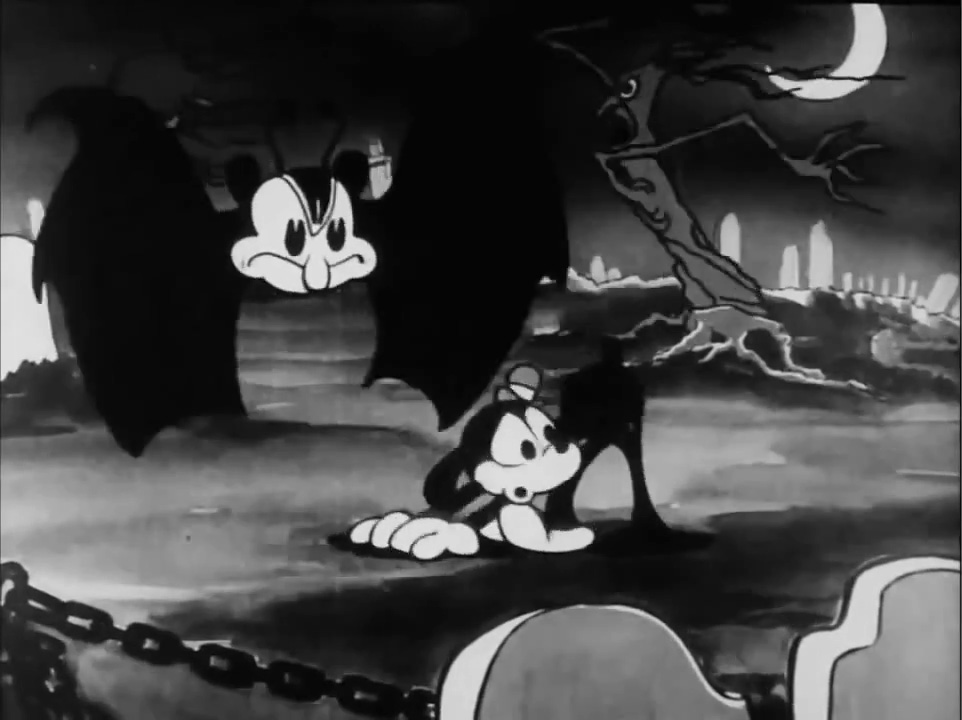 "Goodbye! This is your finish, brother!
You're never going to get away!"
As they sing, Bimbo hides his head in the dirt but it comes back out on top one of the graves balancing a bone on his nose, he develops what I believe would be a yellow streak down his back if this film weren't in black and white, and the ground next to him turns into a giant mouth that tries to bite him. Bimbo frantically shimmies up a flagpole, and screams, "Oh, no!" but a tombstone with a face makes itself as tall as the flagpole and answers, "Oh, yeah!" Bimbo falls to the ground, but another tombstone sprouts arms and softly catches him, releasing him to be tortured further. A ghost pops out of a nearby grave and sings:
 "You'll never rob another's henhouse!"
The plot of grass on the grave shoots up to look like the hair on top of a face made of dirt, who adds:
"You've sinned, and now you must obey!"
[Note: I think the last word is "obey," but may be wrong. I am fairly certain he sings "must" but the last two syllables could be "go pay" as well, but that sounds clumsy to me. Shoot me a note if you believe otherwise.]

Once more, Bimbo cries out, "Oh, no!" and this time a chorus of female ghosts and the grave plot sing back, "Oh, yeah!" The chorus sings:
"Oh, no, you never rob your brother!"
A ghost who looks like Monroe Silver, a popular comedian of the day who employed a Jewish dialect in his routines, turns his palms upward and says, "Ya needed it!" And then the chorus sings:
"And now, we'll haul your bones away!"

At the song's close, a skeleton puts a "For Rent" sign on an open grave, causing Bimbo to shiver with fright. As the ground tries to drag Bimbo under the cemetery, another section of music begins, and various creatures and objects sing of his litany of crimes, while Bimbo tries to defend himself:
Bat: Chickens you used to steal!
Bimbo: I don't steal no more!
Tree: Craps you used to shoot!
Bimbo: I don't shoot no more!
Shadow: Gals you used to chase!
Bimbo: I don't chase no more!
Tree: Get ready, brother --
All: Your time has come!!!


 Bimbo desperately tries to escape as the walls of the cemetery march toward and close in about him until he is tight in their embrace, but he squeezes out at the top, avoiding their spikes, and zipping away. He runs to a nearby barn which creates a mouth that swallows Bimbo inside, where a large black hand continually tries to grab him, and ghosts and all manner of monsters sing, play, dance and threaten him through song...
"Stand up, you sinner!
We've got you at last!
You can't get away,
there's no time to pray,
your finish is g'wine to be fast!
Brudders and sisters,
come on, get hot!
'Cause I'm gonna take your vo-do-de-o
and tie your bones in a knot!"


 While Bimbo continues to elude a haunted haystack, the various ghosts, and the black hand, a chicken takes over in the second verse, and then does some scat singing before starting to dance. It's body gets more and more rubbery and its legs stretch out until it is several sizes taller than it once was, filling the screen. Two ghosts with top hats do a quick dance routine, slapping their rears from side to side, and then a strange figure that appears to be a pair of pants with eyes joins in. It splits into three bean shaped figures with legs that strut for a while. An empty pair of shoes clops down some stairs, then the boards from the stairs march away, revealing a pair of ghosts in each step, who sway from side to side.


 The second ghost (that sounds somewhat like Cab Calloway) produces a noose and hangs it in front of Bimbo. It sings...
"Brother, you sho' gonna get yo' face lifted --"
...while the trombone ghost whips out a straight razor and adds...
"-- and a permanent shave!"

All the ghosts gather around Bimbo and add "Ha! Ha! Ha!" Bimbo runs in circles around one ghost, and it spins and spins with his motions until the ghost becomes a barber pole. The straight razor ghost steps from behind the pole and with a terrifying grimace, threatens Bimbo. It takes a swipe at the dog with its razor and cuts the top part of his hat off, but Bimbo's ears reach up and pulls the hat back down in place.

Bimbo runs out of the barn and runs down a road where the telephone poles throw a row of shadow crosses in his path. The barn sprouts legs and gives chase. The ghosts pour out of the windows in the form of giant faces, including one that looks like a crazed Uncle Sam with incredibly long hair (though this might be another Jewish stereotype), and continue singing behind the back of the fleeing Bimbo. Dragons and horrid tentacled creatures join in the chase, and what seems to be a mile-long chain of ghosts wave their arms and pursue poor Bimbo up and down over hills until he runs with the full cadre of evil breathing down his neck as he runs into a dark cave. Swing You Sinners! breaks out in its full gory glory, with all manner of dancing, frightening creatures swaying and jumping to the deviant music. All hell breaks loose...

"You can't make any excuse!
Oh, get square with your goose*
'til we've picked up your noose!
Swing, you sinners!
You'll make a chicken 'scalope!*
You're at the end of your rope,
so just give up all hope!
Swing, you sinners!
We'll stretch you like a giraffe,
maybe cut you in half!
Just you give up that laugh,
Swing, you sinners!"

[*Note: once again, if you feel strongly about changes to these lyrics, plead your case in a comment. I am fairly certain of the other lines, but the ones marked with asterisks are iffy to me. It does however, make sense to me that they would threaten to turn him into a chicken escalope, since it is a piece of meat that has been pounded really thin and he is acting like a chicken (and is a hen thief to boot). And also because it sounds that way.]

A skeleton hand with a giant knife takes a swing at Bimbo, which he evades, but he is finally eaten up by a huge flying skull. With that gulp, the cartoon ends both shockingly and abruptly, in what I feel is one of the greatest finales in animation history.

There is so much that jumps out at you in such a crazed flurry of images that it is extremely hard to recount (or remember) all that occurs in this film without, as I have writing it all down. Even then, I left out many details and bits.
As sharp as some of the imagery is, there is also a very sketchy quality to some of the characters, and it comes as no surprise to discover the huge amount of famed animators that actually worked on this film, including the incredible Shamus Culhane and Grim Natwick (though only Ted Sears and Willard Bowsky receive screen credit.) Dave Fleischer's tremendous regard for gags piled on top of gags fulfills itself to the extreme in this marvelously freaky short.

As someone who is always on the lookout for great Halloween material, I find this cartoon aces the creepiness test. In fact, with the fact that there is no escape from Bimbo's tragic fate at all, no matter what he does, this might be the ultimate in "scary" cartoons. (At least he gets to go out with a party!) Where most horror related cartoons kind of soft-pedal the scarier images with cuteness, this film and its humor is clearly aimed at adults, and acts that way to boot.
What I really like are some of the wilder characters such as the long-haired hat wearer and a couple of the goons shown in the finale that have a touch of Basil Wolverton to them. It does make me wonder if this film, or at least the Fleischers' output overall, was an influence on the famous Powerhouse Pepper, Lena the Hyena, and MAD Magazine artist?
As for the oft-touted "surrealism" of Fleischer's early shorts, while it is an often misused term -- where people apply it just because something seems weird or dreamlike to them -- for much of this cartoon the description is most apt, with many of the gags coming completely out of the blue and having no real connection to what came before or what would be coming next.


As for poor Bimbo, he ran into all sorts of problems. Betty Boop, introduced in 1930, gradually became the breakout star of the Talkartoon series, which went away so that the Fleischers could concentrate on Betty's own series. This pushed Bimbo and former silent star Koko the Clown, who jumped from Out of the Inkwell into the Talkartoon shorts, into the background. Bimbo would eventually disappear from the cartoon world, possibly due to the Hays Office. Apparently, they had a little problem with bestiality. (This is odd, since his girlfriend, Betty Boop, did start out as an actual dog character! Look at her earliest appearance and you will notice she has long dog ears.)
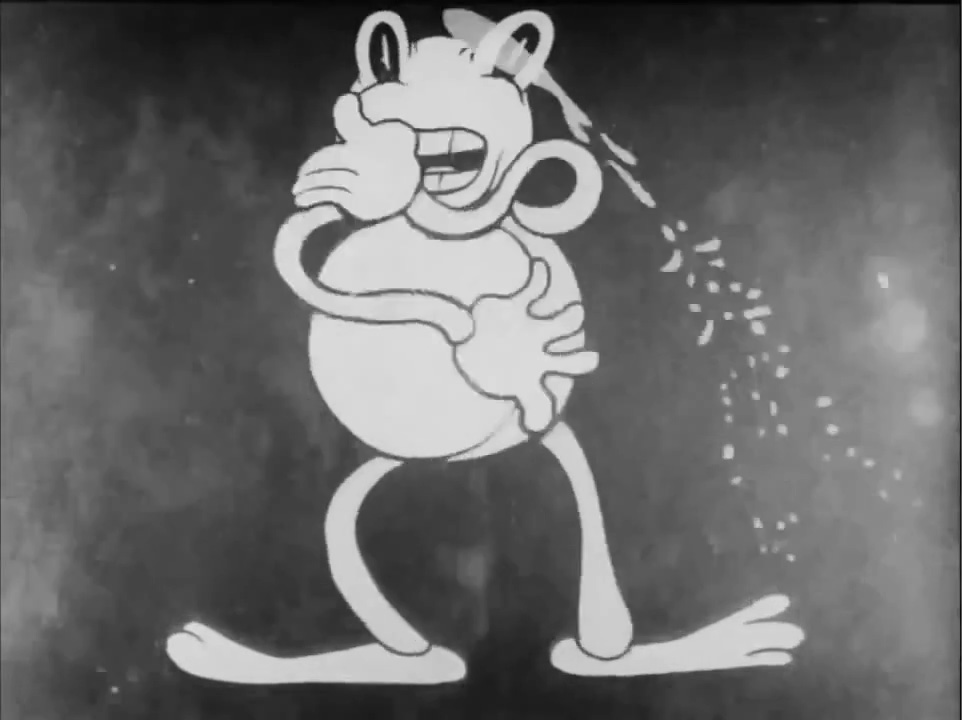

This is reaching for it, but I've often wondered if perhaps Bimbo, despite his white face, was also seen by some in the censorship office as a black character, too; while he doesn't have the outrageous physical stereotypes that most black characters were imbued with in the 30's and 40's, he is black in hue. (Of course, so are Mickey Mouse and Goofy, but they are generally living the WASP dream in their cartoons, especially the later ones in the '50s, and I have never heard anyone with a serious argument that they are represent black characters.) After all, Bosko, who started out at Warner Bros., was generally seen as a black character, and he is not much different from Bimbo. When Bosko went to MGM, Harman and Ising, who created the character, turned him fully and definitely into a small black boy for several more films.

Whatever the reality for Bimbo: Cartoons he used to act in! He don't act in 'em no more!
RTJ
*****
And in case you haven't seen it:


