
 Cap'n Cub (Ted Eshbaugh Studios, 1945)
 Dir: Ted Eshbaugh & Charles B. Hastings
Cel Bloc Rating: 6/9
I must admit to a certain fascination with Ted Eshbaugh. IMDb only has the barest information on him, such as his birth and death dates, and a listing of 7 films that he directed in the 1930s and 2 in the ‘40s. At least one of those films is quite well-remembered, The Sunshine Makers, a favorite from the Van Beuren Studios that is not quickly forgotten by anyone that has seen it. He also produced the first film version of The Wizard of Oz that split the mundane Kansas sequence and the fantastical Oz sequence into black-and-white and color sections. (This animated short can be found on the most current DVD of The Wizard of Oz from 1939.)
But not much more is mentioned about him, and there is also little information about Cap'n Cub, a wartime propaganda piece he produced and co-directed in 1945. [Editor’s note: when this piece was first posted on this site, Cap’n Cub didn’t even have a page in IMDb.] In this film, a small bear cub, who is unsurprisingly called Cap'n Cub (which leads me to believe that he is a a cub who holds the rank of Captain), is the head of a troupe of like-minded animals fighting the Japanese menace in the Pacific Theatre during World War II. It's one thing to see rougher-edged adult characters like Bugs Bunny or Daffy Duck take to the trenches, or to have a hero of the stature of Superman fighting in wartime; in either case, you sort of expect that they would be brought into service, at the very least to entertain the troops. Even Donald Duck, with his fiery temper, is a decent match against Hitler and his cronies. But, a small, cute, cuddly bear cub? Aren't there age limits for recruitment (forget species limits)? And how did he rise to the rank of captain at such a tender age?
 We find out very quickly why this is so, but it is certainly not from the poem he recites at the film's beginning. After a “rousing” (zzzz.....) and militaristic gung-ho song extolling the heroism of the "Army, Navy and Marine Corps" plays over the opening credits, as Cap'n Cub buzzes about the skies in his cute yellow fighter plane, he speaks to us poetically in a squeaky kid's voice, and when he finishes the verse, his voice goes up in pitch with the last couple words:
"I'm Cap'n Cub!
I can sink a sub,
Atlantic or Pacific!
I hate to boast,
But from coast to coast,
They all think I'm terrific!"
 There's nothing worse than a kid with confidence and ego, but it was wartime, and if Cap'n Cub could deliver the goods… well, he was better than nothing. Cap’n Cub circles over a field, banks his plane, and runs in for a perfect landing. He hops out of his cockpit, and marches up to his jowly bulldog of a general, whose uniform jacket is covered in important-looking medals. "We're ready for the review, Cap'n!", the general harrumphs, and the pair walk to a podium in front of rows and rows of spectators. The general blows his whistle, and some dog soldiers in a marching band start to drum as their leader twirls his baton. A line of tanks roll in for the review, but these are no ordinary tanks. In fact, they are turtles wearing helmets, and with cannons mounted inside their shells. They start firing in accordance with the review of armory.
The general remembers, almost too late, what is rolling in for review next, and after nudging Cap'n Cub, they both put on gas-masks. We then see why: a trio of skunks pushing stink bombs come into view, followed by a lovely lady hippopotamus, who squirts perfume from a large dispenser as she skips merrily after them. Three puppies roll up with a huge cannon, and they are met by an elephant from the Camouflage Corps, who bicycles up to them disguised like a Good Humor Man, cart and all. He gives them some camouflage paint, and two of the pups (the third is the driver) deftly and quickly coat their sections with the paint. But, it is not normal camouflage cover, for it makes the gun disappear entirely, and so the two pups are left looking like they are sitting in midair. The gun is raised, but we don't see it and only know it is from where the pups are sitting, and fired, and the pups slide down to meet the third, who drives off, making it appear that they are pulling nothing behind them.
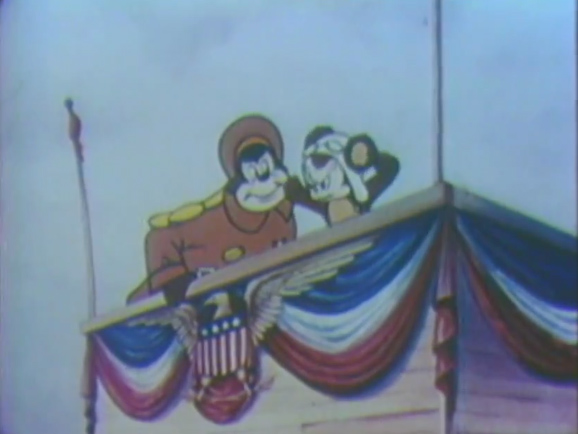 "How do you like it, Cap'n Cub?," the general asks."Well, plainly speaking," Cub begins, "what we need are planes, planes, planes, PLANES!!" He pounds his fist on the stage with each repeat, and the scene dissolves to Cap'n Cub pouring over some blueprints with an engineer. The Cap'n next pumps up the production level of planes by manipulating a lever that changes it from "Planes Per Hour" past "Planes Per Minute" to "Planes Per Second". Thus begins the march of the rubber toys, plungers and whatnots down a long chute and into a processing machine, where each is dropped into a cocktail shaker-shaped bin, which, not too surprisingly, is shaken up until the rubber comes pouring out into a contraption that looks like a waffle maker, only here, they come out as rubber tires.
 Scrap metal is poured by the bin into a machine that is cranked, and then the scrap comes out the other side as long sheets of metal, at which point they take a conveyor belt journey to a mold in the shape of a plane. Each of the planes is pressed out one by one, and at the end of the ride, the planes have come alive, and their tires roll on to them, which they test out like new shoes. They skate onto a turntable where they are coated with yellow paint, and they dry themselves the way that dogs shake off water. Then the planes each tiptoe over to a pair of technicians, who fastidiously fasten a propeller to the nose of every single plane. (Of course, forgetting about the whole "Hey, let's put an actual engine inside this baby!" part of the process...) The planes then form a conga line that crosses neatly with another conga line of pilots, most of them similar bear cubs to the Cap'n. I say most, because at the front of the line, there is a fat cowboy bear (he might be the Cap'n's dad, for all we know) and a kangaroo, and the cowboy bear hops onto his significantly smaller plane, straddling it where he would normally fit into the seat. (It's like Slim Pickens on the back of that a-bomb in Dr. Strangelove.)
 All of the planes take to the air, and in the form of a flying "V", with Cap'n Cub at the point, they fly into some low clouds. When Cap'n Cub comes out, he is surprised to find that he has lost his squadron, and it has been replaced with a flock of ducks. He zooms ahead to retake his position, but ominous-looking planes are spotted not far in the distance. As they inch ever closer, with a subtly Asian flavor overtaking the film score, the Cap'n shouts, "It's the Japs!" Cub starts blaring a charge count on his bugle, and then he orders squeakily, "C'mon, fellas! Get' em!" The squadron charges the Japanese fighters, which scatter and gobble like turkeys with the attack. The fat cowboy bear is shown in closeup, scanning below his plane for the enemy, his pair of six-guns welded to his hands. Finally, he spies his target and swoops down, six guns blazing, causing holes to erupt in the wings of a couple planes. He then takes out four in a line, before blazing off into the distance.
The kangaroo pilot crawls out its seat, laboriously hefting its massive pouch up onto the plane's hood, and then pulls a machine gun out of the pouch. Stepping onto the wing, it fires at a coming plane, which fires back immediately. The shell shatters the machine gun, but the kangaroo has nothing to fear: its baby joey pops out of the pouch, too, blasting a double-barreled shotgun at the Japanese plane, which goes down in flames. The joey turns to its parent, and proclaims proudly, in the popular manner of Red Skelton, "I dood it!"
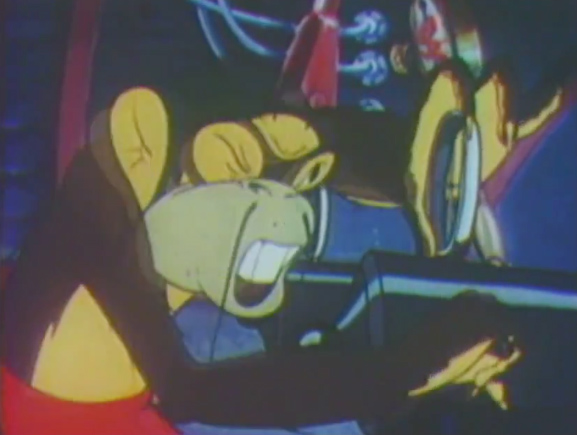 Cap'n Cub is silently pursued by a single enemy fighter, and when we are given a glimpse inside the plane, the Japanese pilot is portrayed as a long-tailed monkey with buck teeth, slanted eyes, two long strands for a mustache, and goggles (standing in for the requisite glasses). After lining him up in his sights, the pilot fires at Cub, whose plane is only grazed, and is able to bring his cute little plane to rest on top of a cloud. He shouts, "Why, you slappy Jappy, I'll knock ya sappy!", as he shakes his fist at his enemy. Cub attacks, and the Japanese fires shell after shell at him, but even through all the smoke and the bullets, Cap'n Cub escapes. He attacks each section of the huge Japanese craft, circling around wings and engines alike, firing bullets rapidly into them. His plan works: as each section starts to fall away, the pilot has to work strenuously to pull the parts of his plane back together. Soon, every part of the bomber is being held by its wiring by the monkey pilot, and he scurries from section to section as the plane slowly starts to fall out of his control.
 The midsection frame starts to spin, and every section fans out around it, and the pilot is spun around like he was on a merry-go-round, as calliope music is pumped on the soundtrack. He pulls the plane together again, but Cap'n cub shoots the bottom out, and the pilot is dropped down, hanging from the cords and jerking as if he were a marionette. Suddenly, he is sucked back up into the plane, slammed into the cockpit seat, and the cords wrap him tight to the chair. Cub shoots away every bit of the plane, except for the seat, the engines, and a bomb, which bounces up and down below the pilot. It finally springs up and hits the seat, there is a huge explosion, and the Japanese rising sun design is displayed in the clouds. With the skies safe for democracy, Cap'n Cub takes the lead of his flying wing once again, and as his squadron spreads out behind him, he flashes the "V for Victory" sign at the camera.
It is unfortunate that the print I was viewing is cursed with about a 10 to 15 second segment where the blazing Technicolor gives way to a washed-out black-and-white. The problem here is that this might be the only print in existence. That said, the rest of the film is as bright as color can be in a film, if perhaps a little too garish at times. Why blinding yellow planes? Why do the characters fire hand-held guns at the Japanese, but not have guns mounted on their planes? I don't know, but, to be honest, these aspects are as much mysteries to me as anything about this film. And Ted Eshbaugh himself. Maltin mentions him briefly in the Van Beuren chapter in Of Mice and Magic on two pages, and when he leaves Van Beuren, Eshbaugh leaves the book too. A search on Google brings about scant mentions of Eshbaugh on numerous sites, but they are generally just a few words here and there, and mostly of the "He directed this film in this year" category. Even his Wikipedia page merely lists his films and says he was "an American animated filmmaker". (I assumed he was animated at some point since he seems to have lived on this planet. Hard to be a filmmaker if you aren't animated somehow.)
Not an enigma, though, is the choice of how to portray the Japanese pilot. It is a sad fact that we seem to have more tolerance for negative racial portrayals in the midst of war than we do in times that are not. This, of course, depends on if the portrayal in question is that of a group which we are fighting. I, personally, do not approve of it. I merely understand it. Is the choice of a monkey for the Japanese pilot unfortunate? After all, it's just another animal in a film full of animals at war. No, the hurt comes not from the choice of animal for the portrayal (though its frenetic antics are meant to jibe with those of a Japanese individual), but mainly derives from the facial features with which the character is imbued. These features come to the fore in many wartime pictures, either as direct representations of either Emperor Hirohito or Prime Minister Hideki Tojo (who both wore small round glasses) or of the Japanese race in general.
The prime example of this hesitancy to denounce such actions may be found in Disney's choice to release How To Be A Sailor on their The Complete Goofy DVD set. Let me preface this by saying that I want this short to be on DVD. The bulk of the cartoon is humorous, it just happens to end with a quick burst of wartime xenophobia, as Goofy takes to the seas to sink a fleet of Japanese submarines endowed with giant glasses, thin mustaches and big buck teeth. You know, the things that the Japanese put on all of their modes of transport. As said, I want this short to be on DVD, but I want it in a collection, like their On the Front Lines set, which children are less apt to play, and one in which proper historical context can be explicitly displayed and discussed. But, to wake up one morning, and wander out to the living room to find your 5-year old nephew watching the Goofy set, and worse, coming to that moment in the cartoon? There were looks of embarrassment all around the room, but the moment whisked right past my nephew. But, what if he were a few years older, and ran into that film? Would he have been more likely to pick up on such stereotypes? I know that the Goofy set wouldn't be "Complete" without that film, and I certainly don't want it edited, but they could have hidden it via Easter Egg or gotten Leonard Maltin to provide some context, since it is the "character" sets, like Donald, Goofy and Mickey, that parents are most likely to purchase for their family's viewing.
And yet, Disney still won't release Song of the South, with or without proper historical context. Are they picking and choosing which racial groups they will upset and those they won't?
[Editor’s note: The text and photos in this article were updated on 11/2/2015.]


